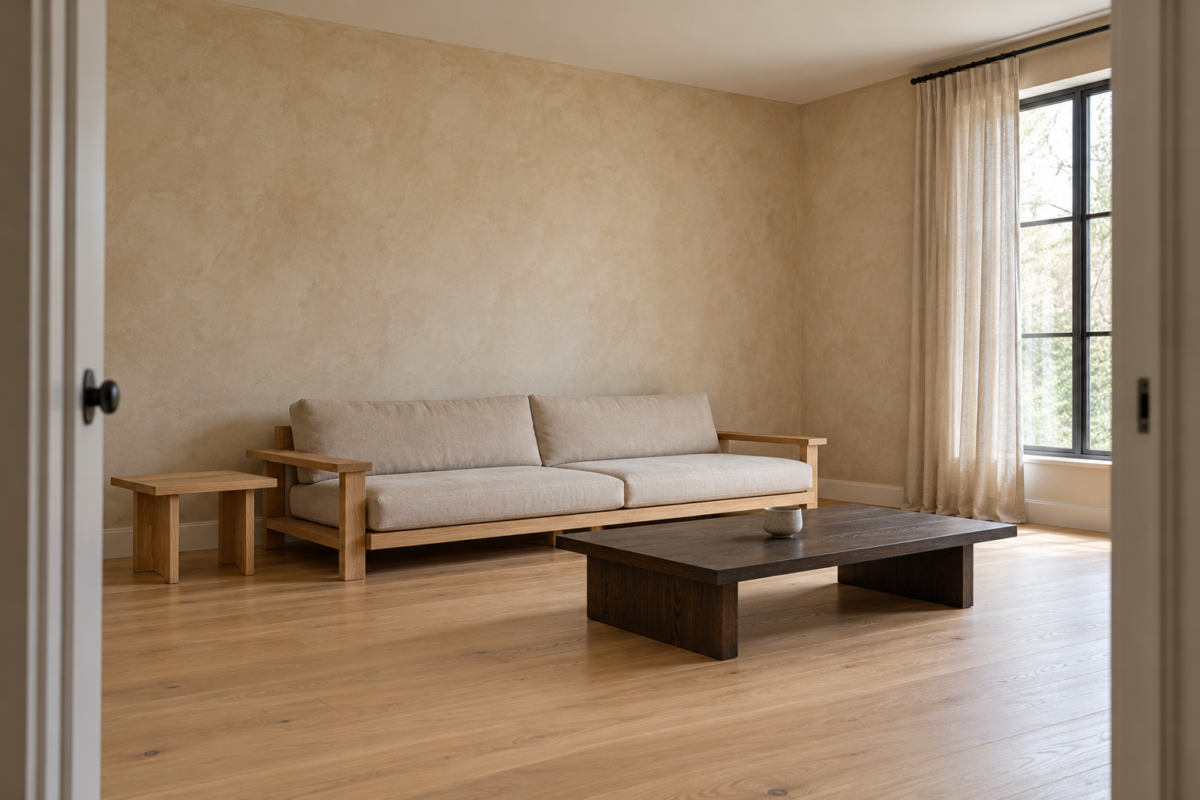
Most of what makes a living room look Japandi happens below the windowsill. The sofa sits low, the tables sit lower, and the wall above them stays mostly bare, so the eye travels across plaster and wood before it reaches an object. The style borrows from Japanese rooms and from Scandinavian ones, and the two share a liking for pale wood, plain cloth, and very little on display.
What separates it from bare minimalism is warmth: wood with its grain showing, plaster with some movement in it, paper and linen that let light through softly. A room can have all of that and still hold a TV, a sofa long enough to lie on, and the cables and remotes of ordinary life, as long as those have doors to go behind.
Sit Closer to the Floor
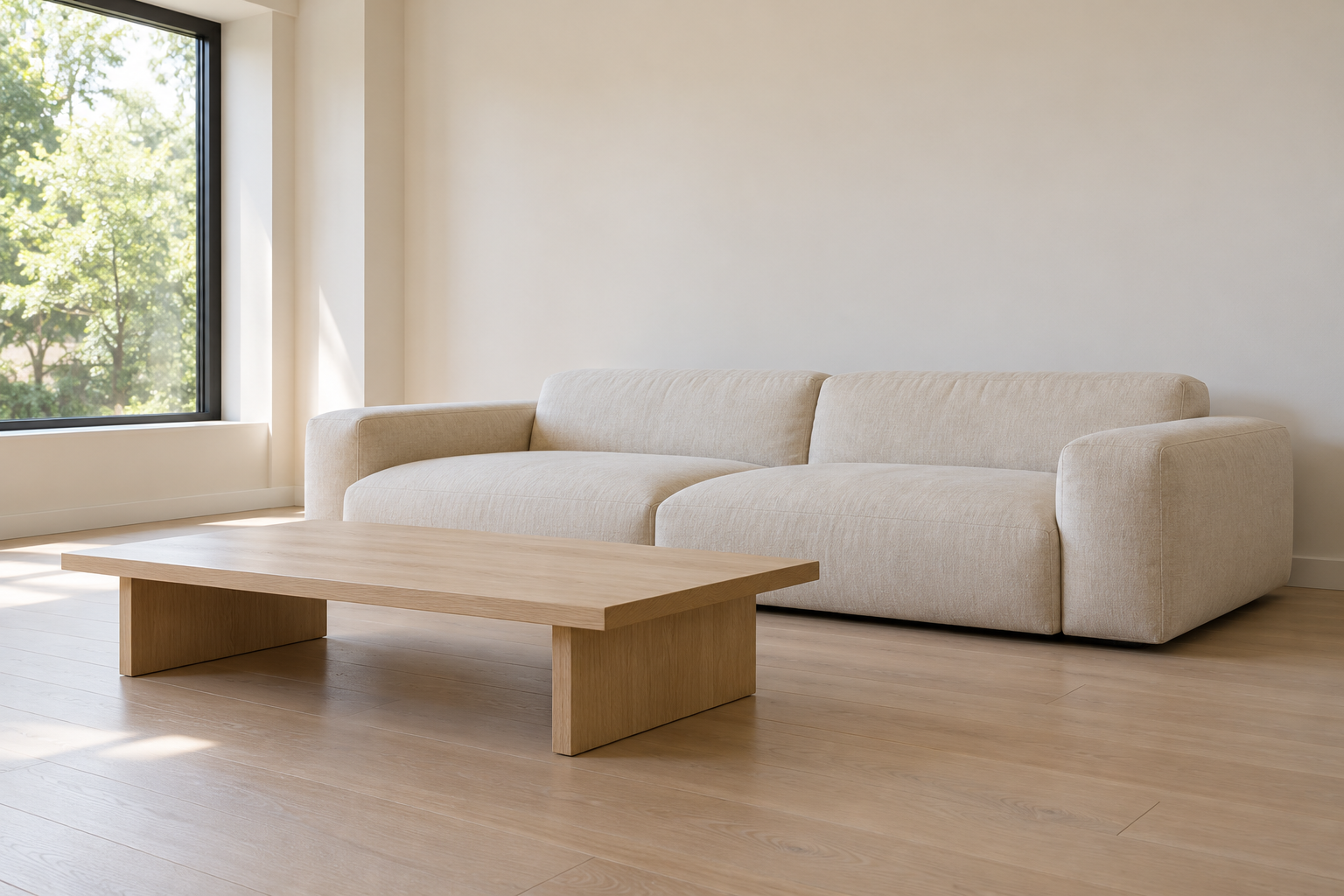
A Japandi sofa often has its seat around 15 or 16 inches from the floor, a couple of inches below most sofas, with a low back and arms not much higher than the cushions. Lowering the seat lowers everything around it, the coffee table, the side tables, the lamplight, and leaves more plain wall above, which is a large part of the look.
A low seat is harder to get up from. A seat around 16 inches with a firm cushion keeps most of the low line and is easier on the knees than a deep, soft one closer to 14.
Pale Oak Against Dark Wood
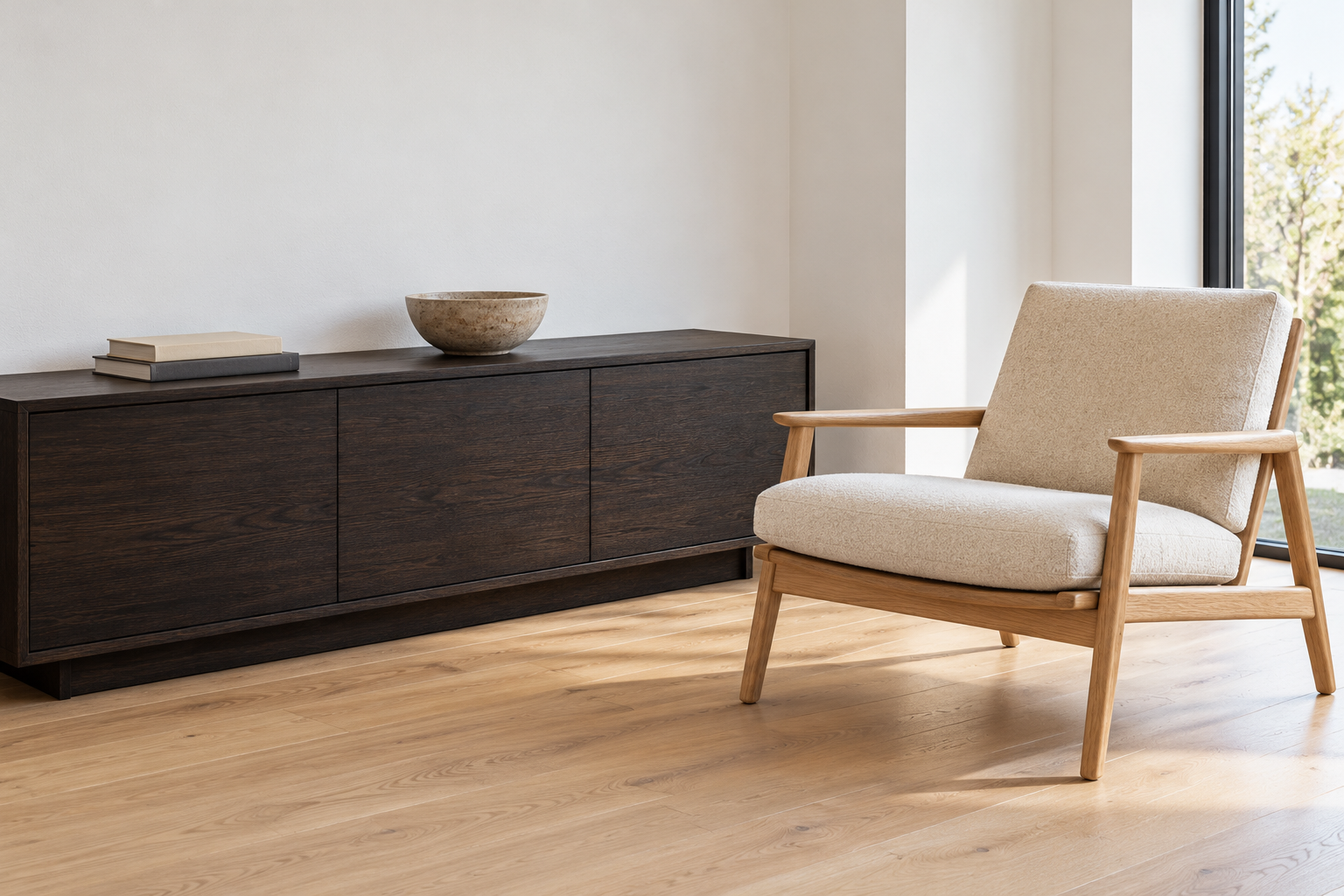
Scandinavian rooms lean toward pale woods such as ash, birch, and white oak, while Japanese interiors often use darker stained or aged timber. A Japandi room usually has both, and the contrast gives a mostly neutral room its structure. Pale oak on the floor and the seating, with one or two pieces in a dark stain, a sideboard or a low table, is enough.
Keep the grain visible in both, with an oil or matte finish. Two clearly different wood tones sit together more easily than three close ones that almost match.
Plaster Walls in Warm Clay
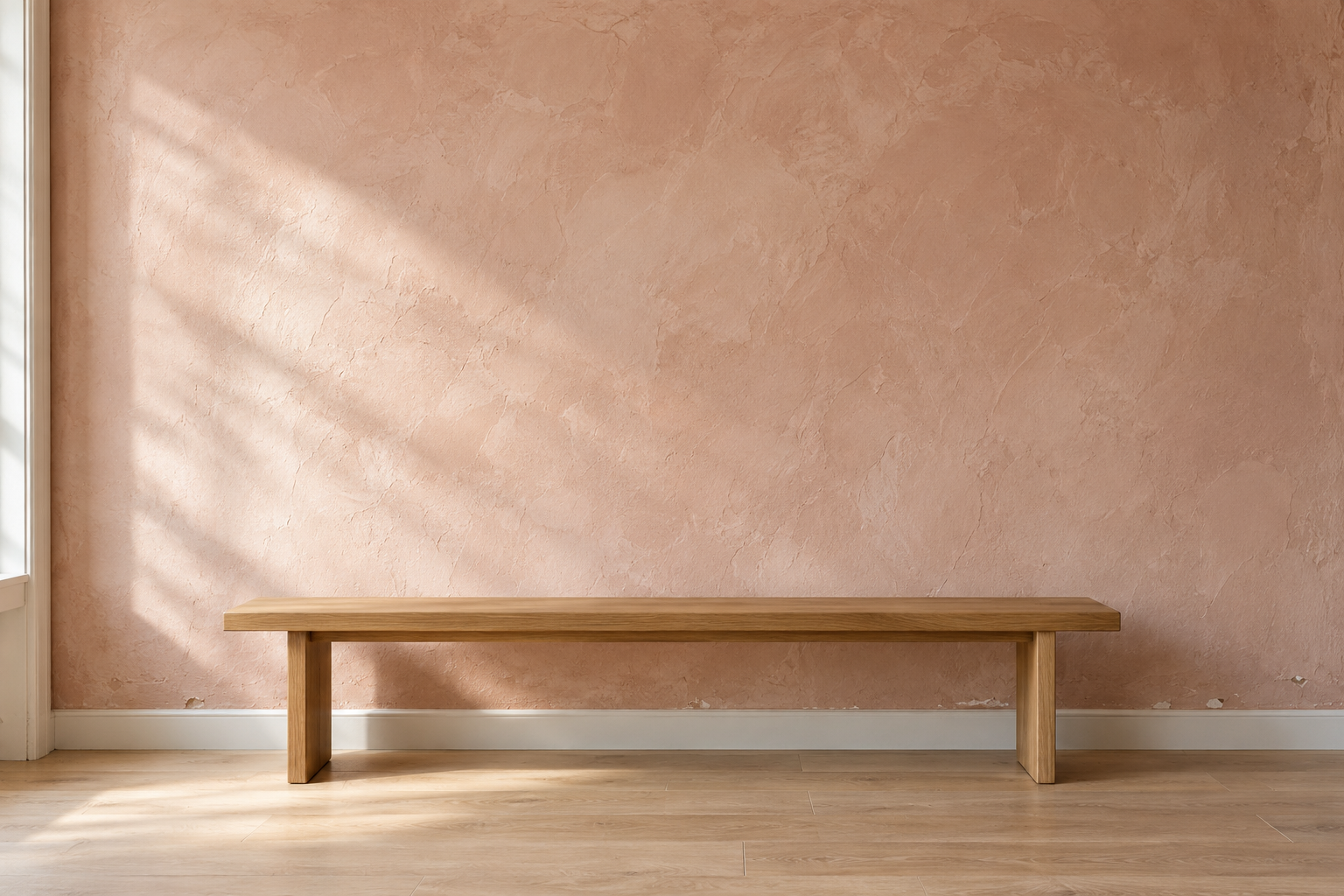
Against smooth white paint, the wood is the only texture in the room. A limewash or clay plaster in a warm, pale shade, sand, oat, or a soft pink clay, gives the walls a slight cloudiness that shifts as daylight moves across them, and the low furniture sits against a surface with grain of its own.
Limewash goes on with a wide brush in crossing strokes, and its movement comes from the uneven coats. Over existing latex paint most limewash needs a mineral primer first, so check the maker’s instructions. In a room where walls get knocked, a clay plaster or a textured matte paint is easier to touch up.
A Paper Lantern Overhead
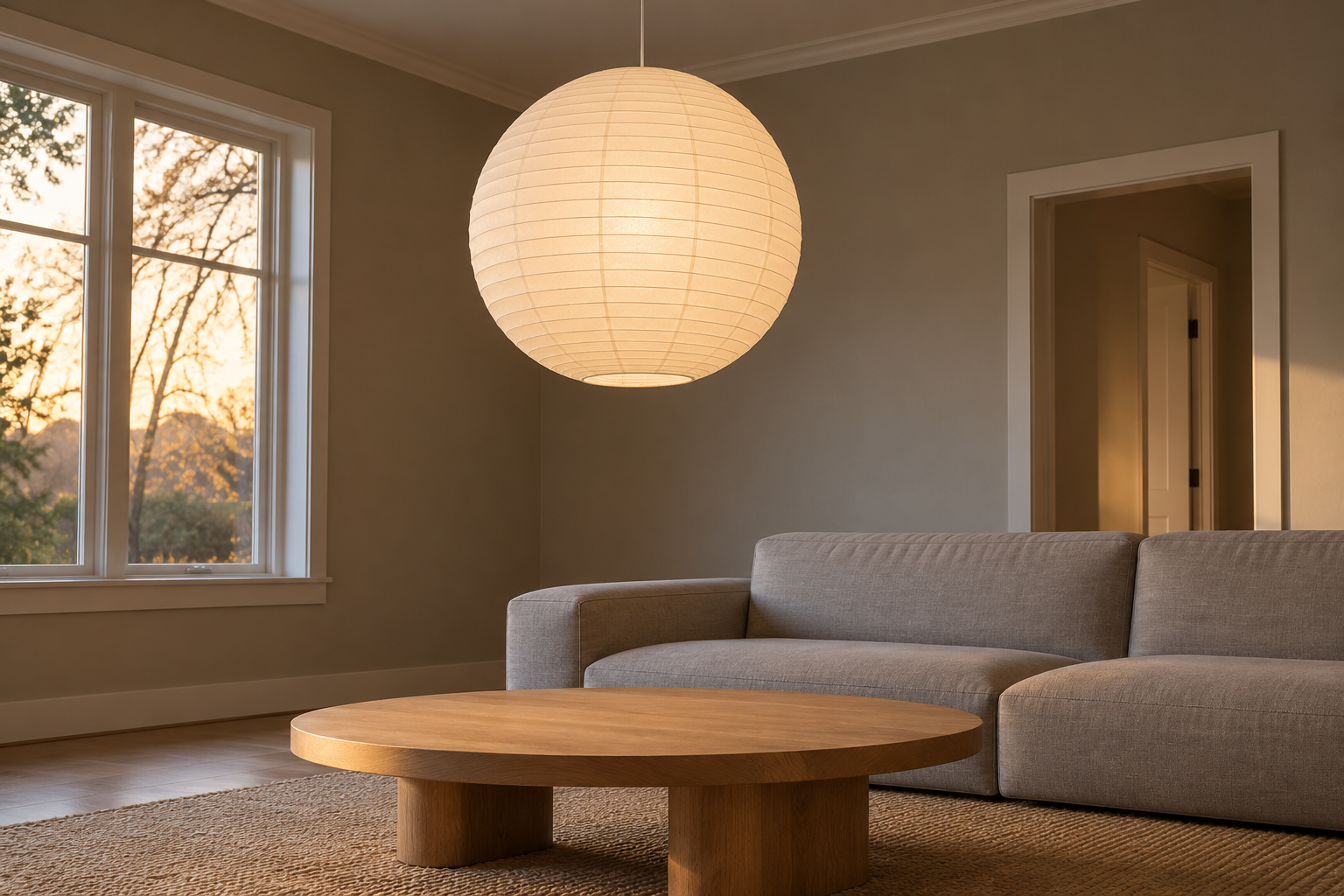
A large paper pendant, a white globe or a pleated drum, spreads light through its whole surface instead of sending it down in a cone, so the ceiling, walls, and floor all get some of it. Over the seating it becomes the room’s main light and the one large object high in a room where everything else sits low.
In a living room of about 12 by 15 feet, a lantern around 24 inches across holds its own over a coffee table. Where people walk under it, keep its bottom at least 7 feet from the floor. Paper browns near a hot bulb, so use an LED.
Floor Left Showing Between the Pieces
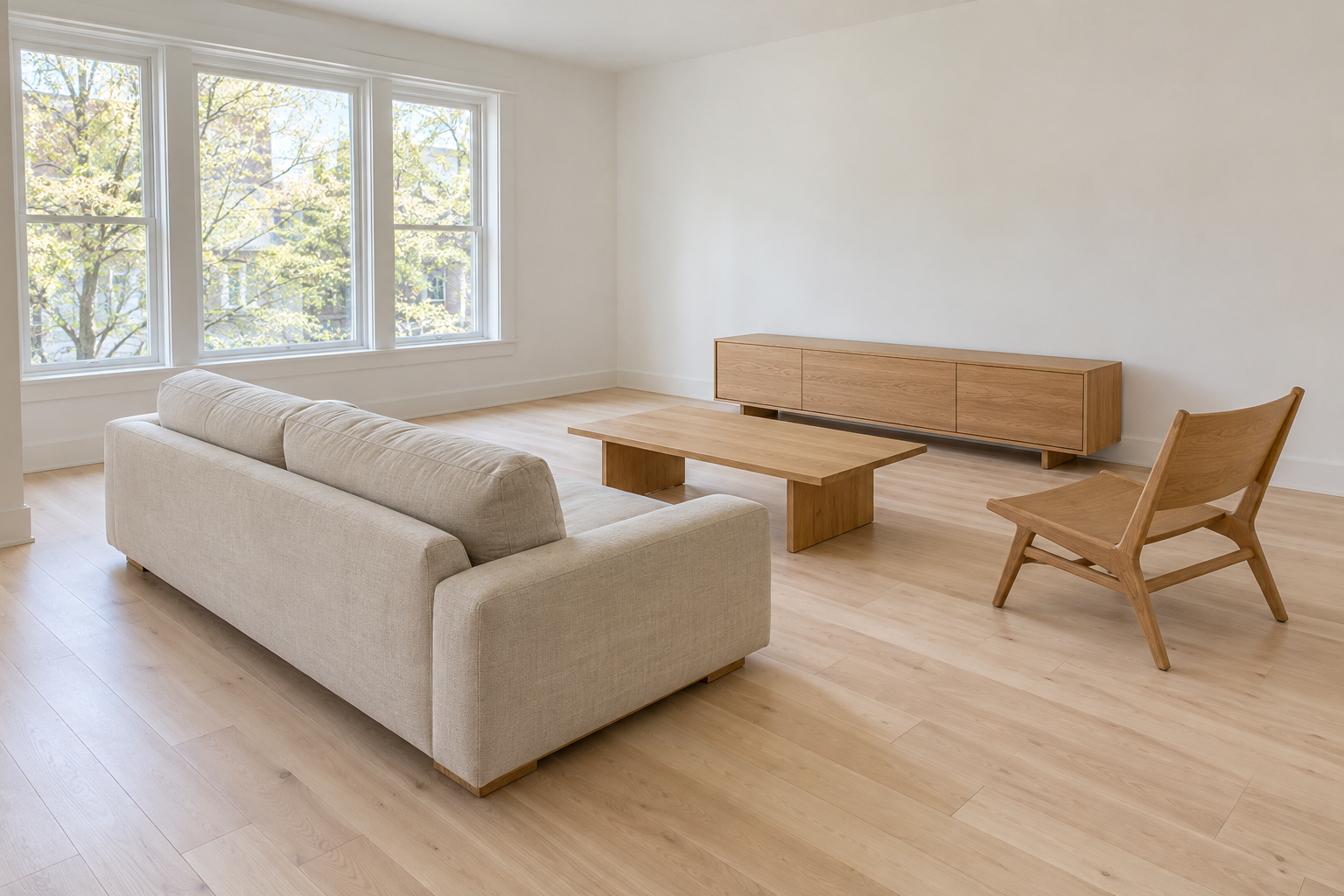
Japanese interiors make a point of the space between objects, and a Japandi living room usually holds fewer pieces than its floor could take. A sofa, a low table, one chair, and a console, with clear floor around each, let the boards show and give every piece its own outline.
That doesn’t mean pushing everything to the walls. Pulling the sofa a foot or so off the wall and keeping walkways of about 30 to 36 inches around the seating leaves floor visible on every side.
Divide the Room With a Slatted Screen
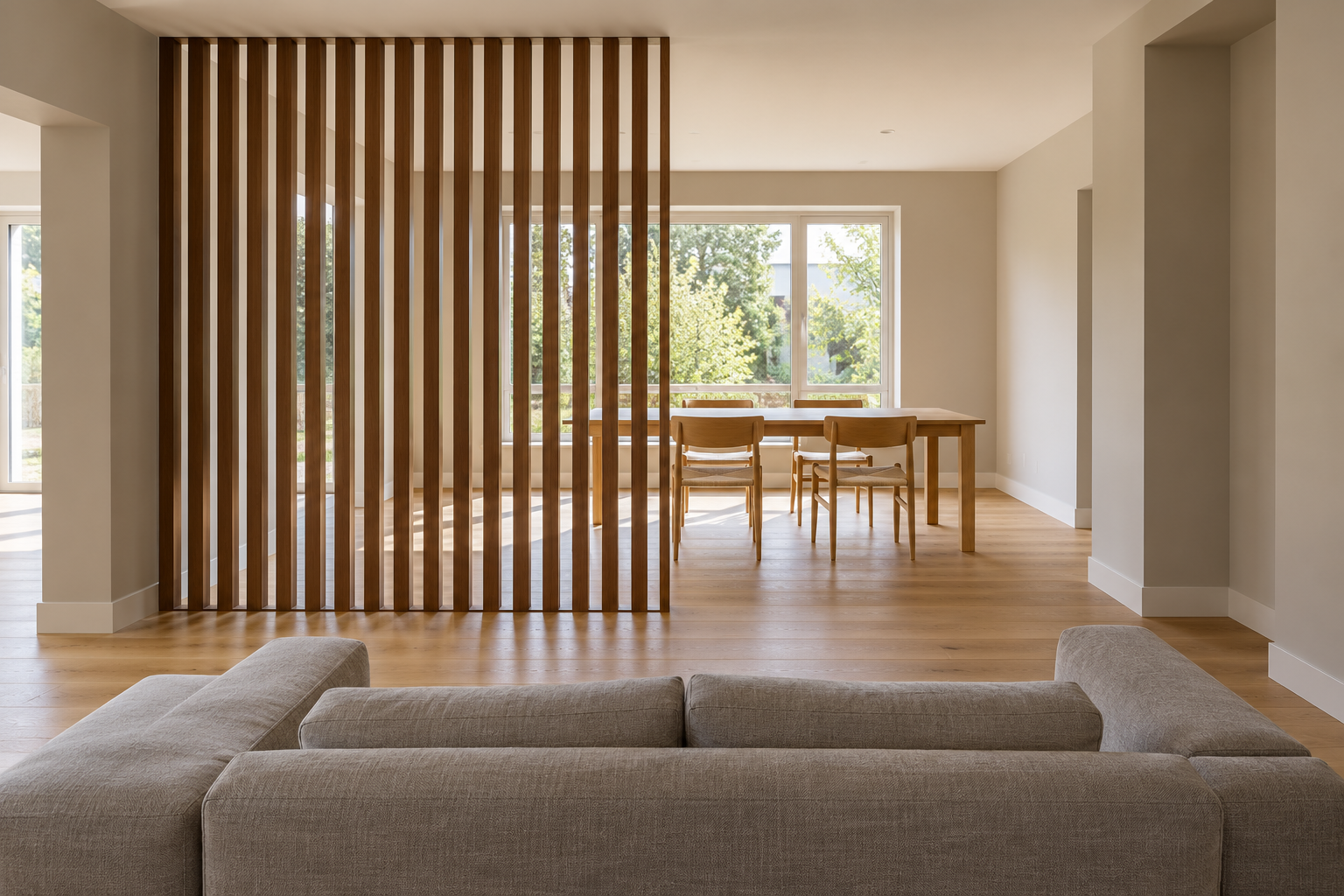
In an open plan, a freestanding screen of vertical wood slats marks where the living area ends and the dining table begins without closing either off. Light and sightlines pass between the slats, so the room stays as bright as before, and the vertical lines recall shoji screens without their paper.
Spacing decides how solid it looks. Slats about an inch wide with gaps as wide again let most of the view through, while narrower gaps make the screen look almost solid. One taller than standing eye level, about 6 feet or more, separates the zones, and a lower one acts more as a backdrop for the sofa.
Stone in One Solid Piece
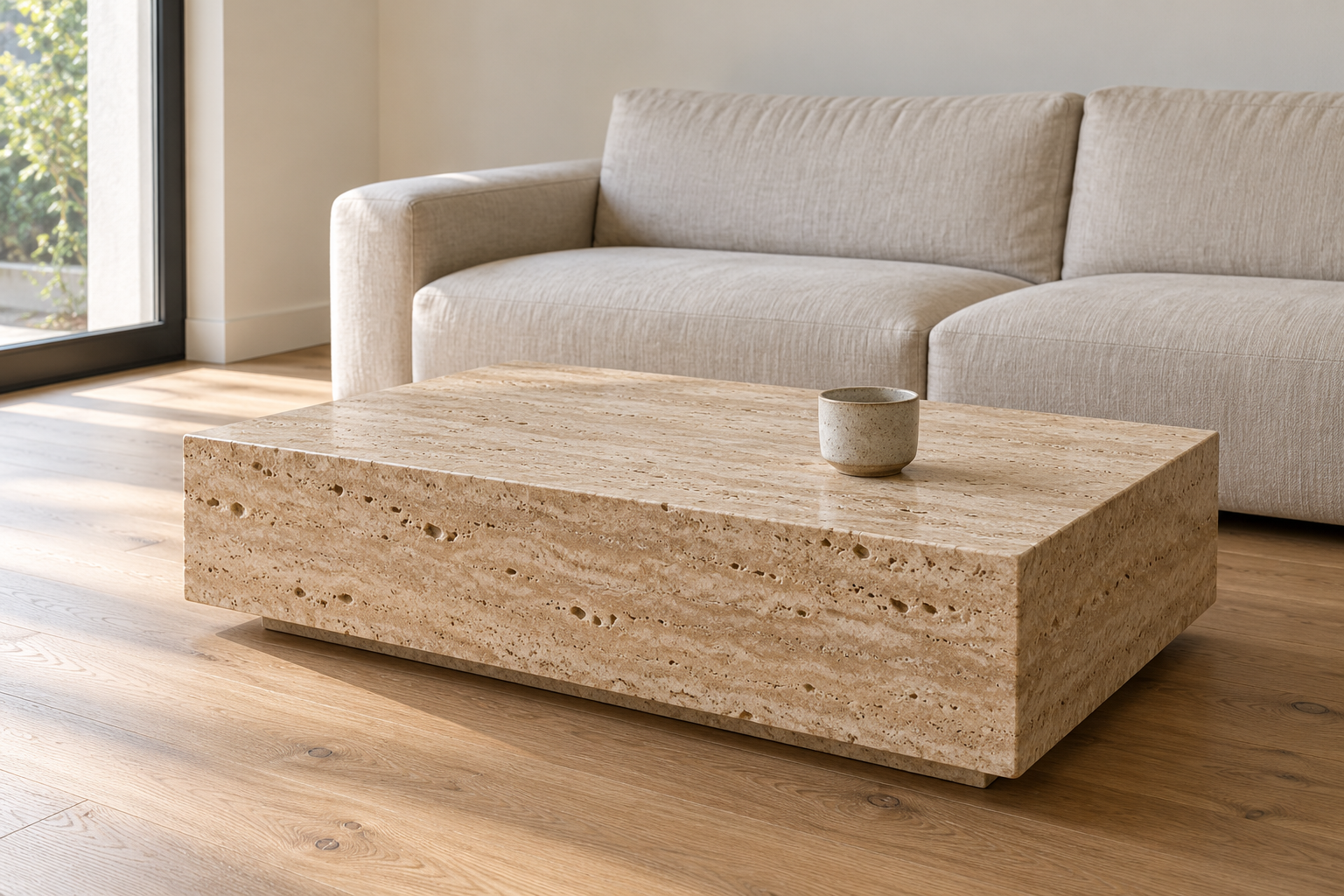
A coffee table or side table cut from a single block of stone, travertine, limestone, or a dark basalt, brings weight into a room of thin wood frames and linen. Its mass sits close to the floor, in keeping with everything else.
A honed, matte surface suits the style more than a polished one, and travertine’s pits are part of its look, though they hold crumbs unless the stone has been filled. Travertine, limestone, and marble etch from lemon juice and wine, so a table people eat from needs a sealer and coasters.
Put Doors on the Media Console
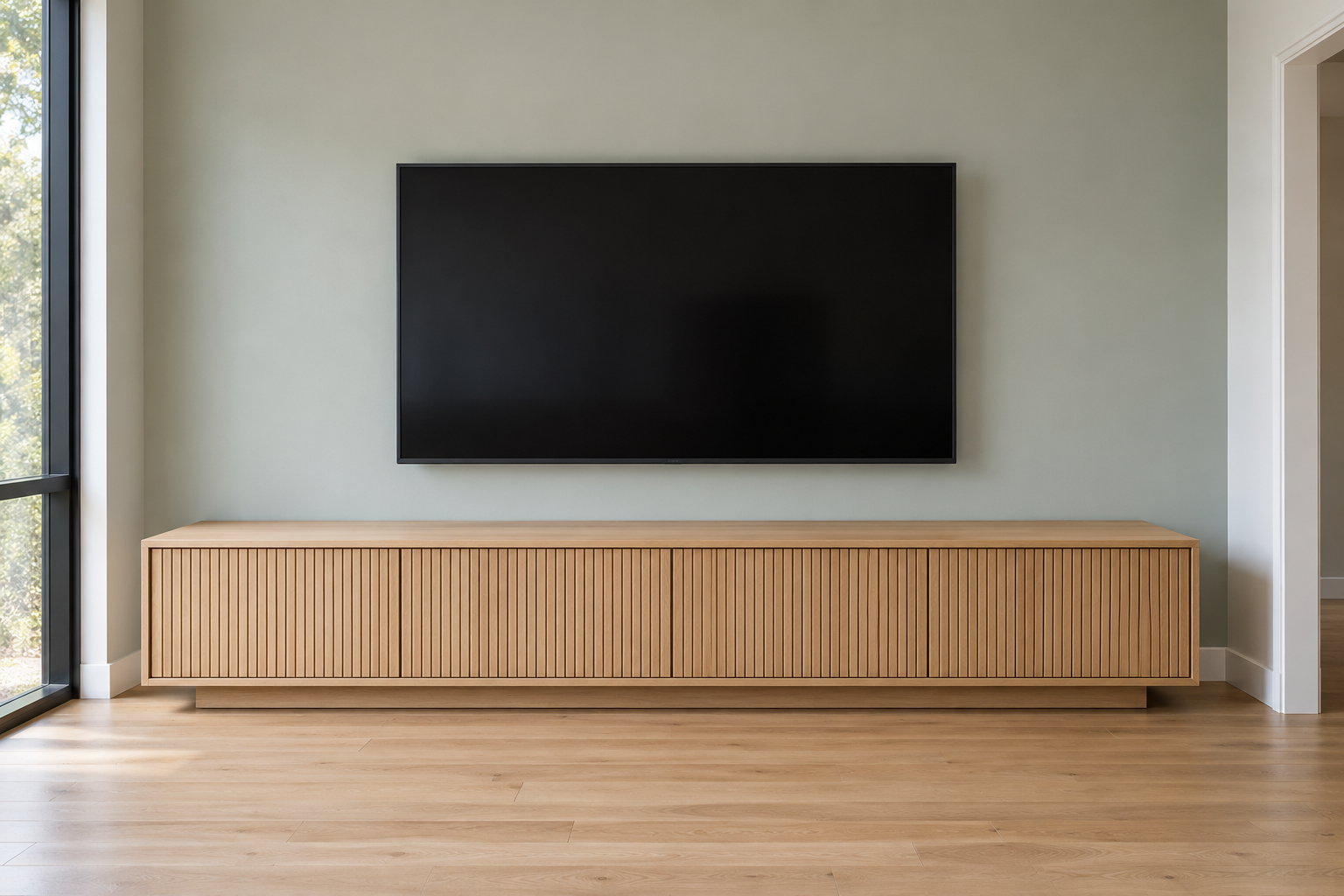
Japandi rooms depend on bare surfaces, and an open media unit fills them fastest, with cables, remotes, and game boxes. A long, low console with doors in pale oak or a dark stain puts all of that out of sight and gives the TV a plain wooden base.
Slatted or caned doors usually let a remote’s infrared signal through, which solid doors don’t, and leave gaps for air around the devices. Cut a cable hole in the back panel before the console goes against the wall.
Flatweave Wool Underfoot
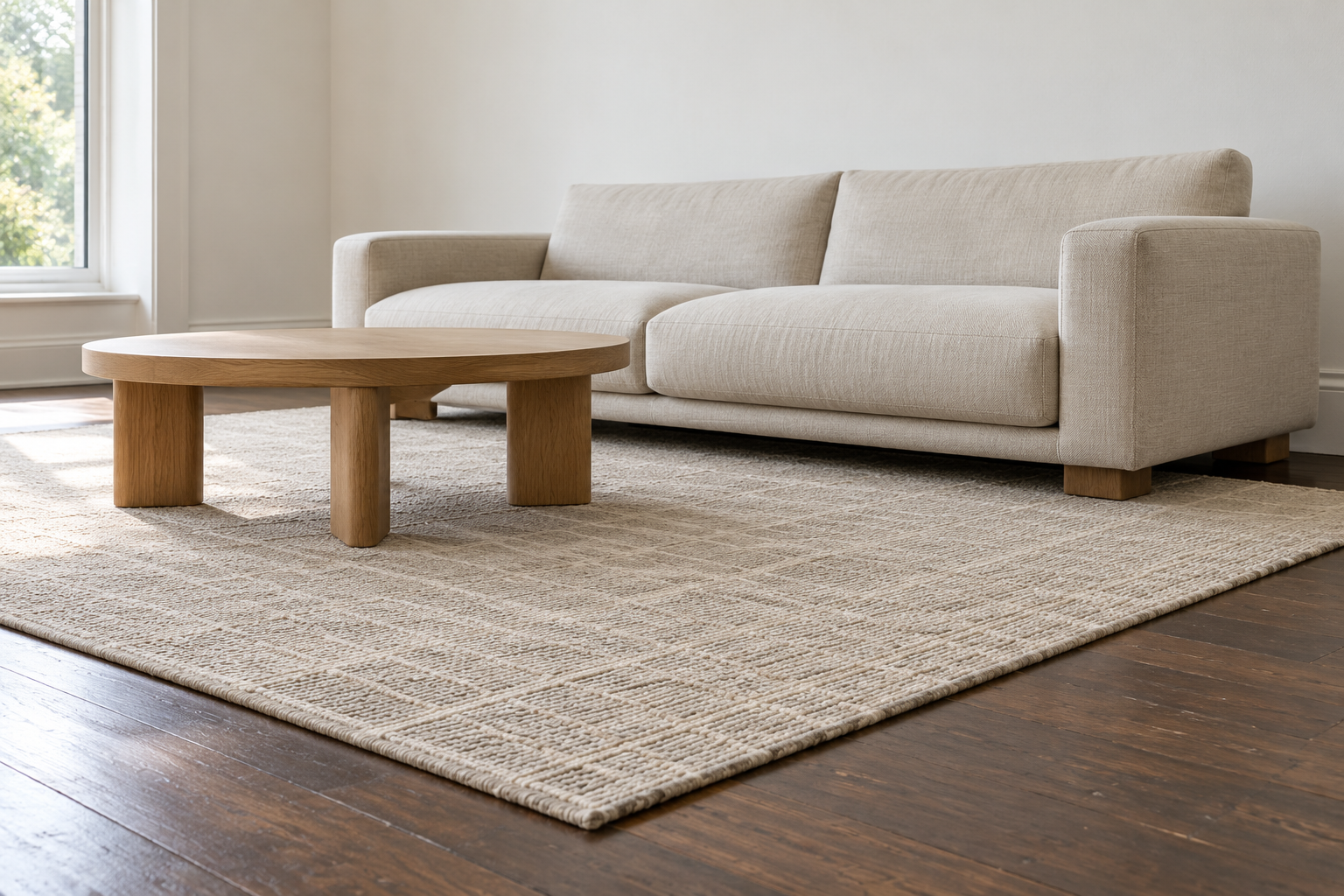
A flatweave wool rug, with no pile, has a texture close to woven matting and keeps the floor plane low and plain, where a shag or a deep pile adds a soft layer that rises toward the sofa. Oatmeal, undyed cream, and stone gray, with a faint stripe or grid at most, suit it.
Flatweaves slide on wood more than pile rugs, so put a thin pad under one. Size it so the front legs of the sofa and chairs rest on the rug.
Black in Small Doses
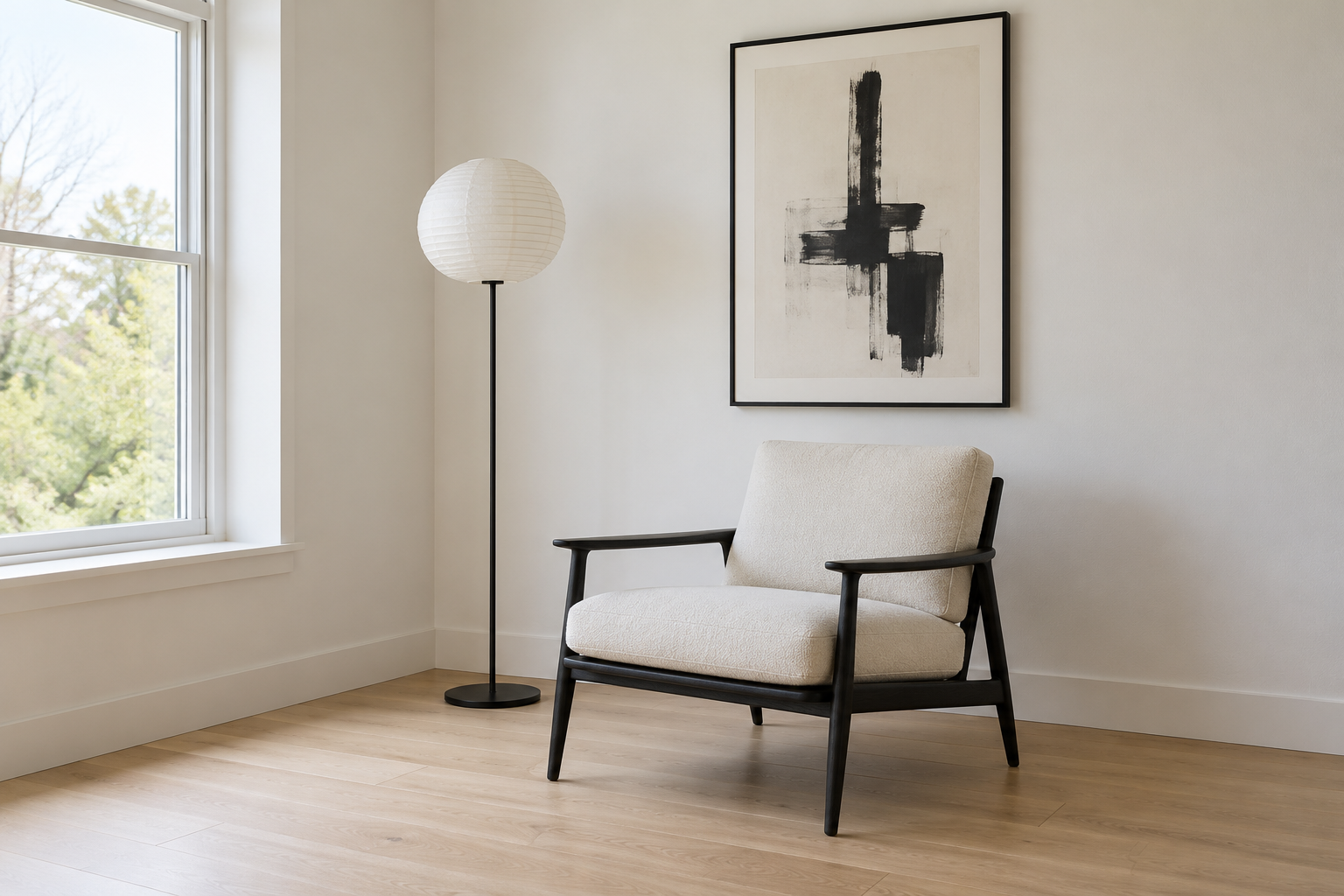
In a room of pale wood and sand-colored plaster, black draws the sharpest lines. A chair on a black stained frame, a black iron lamp base, or the thin black frame of one picture, two or three of them across the room, give the eye places to stop.
Keep each one small and linear, a leg, a frame, a line. A black sofa or a black wall makes the contrast the subject of the room.
Linen at the Windows
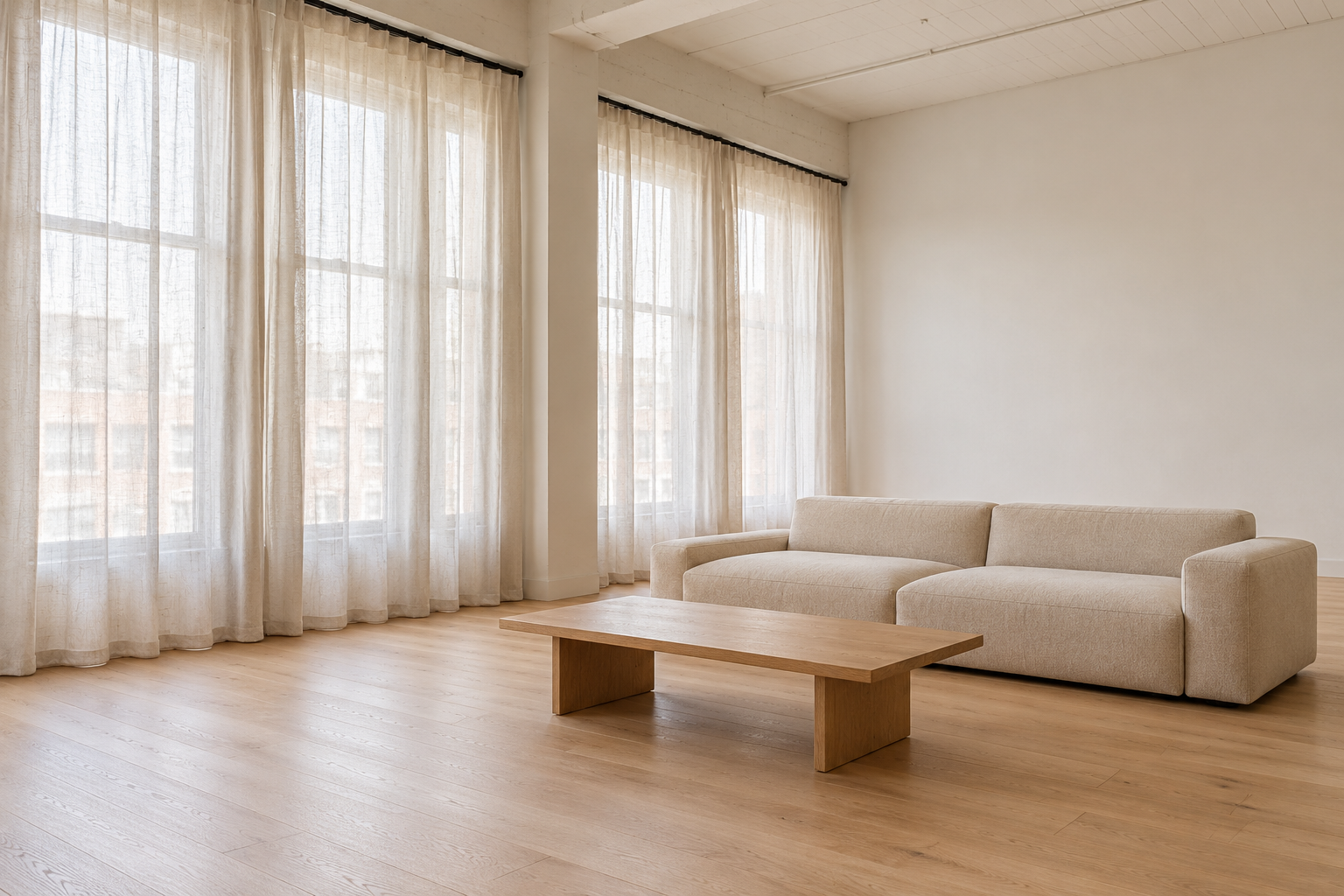
Unlined linen curtains in an undyed or oatmeal shade filter daylight much as paper does in a shoji screen, softening it into an even glow across the floor. Hung from a plain rod near the ceiling and long enough to touch the floor, they add height without pattern.
Unlined linen gives no privacy after dark, when a lit room shows from outside. A blind behind it, or a roman shade in the same linen, covers the window at night and keeps it simple.
One Shelf of Handmade Ceramics
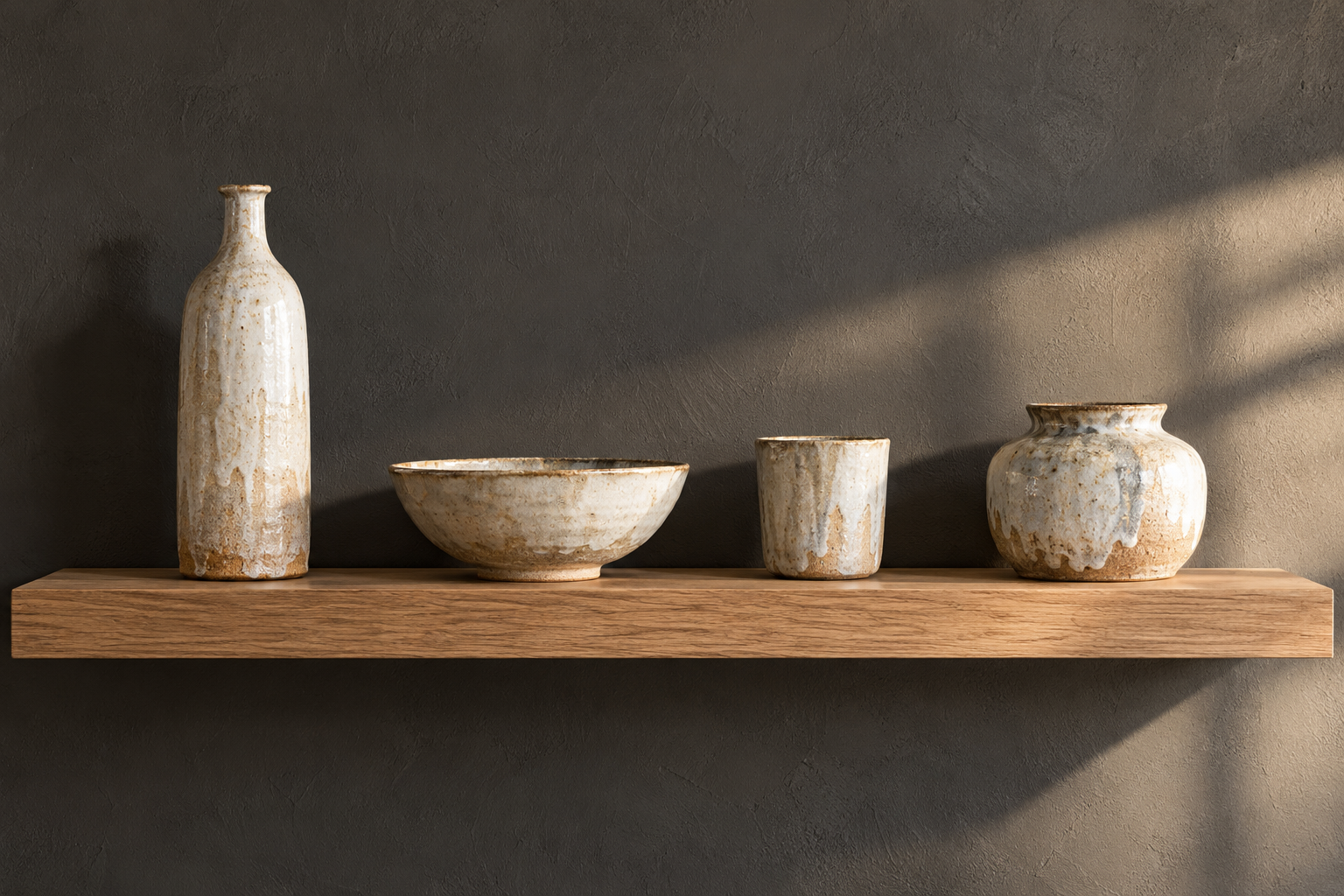
Handmade stoneware, with uneven rims, glaze that pools and runs, and the marks of the potter’s hands, carries the wabi-sabi side of Japandi, its regard for things that are imperfect and show their age. Three to five pieces on one shelf, with space between them, let each shape be seen.
A dark wall behind makes pale glazes stand out. A mix of heights, a tall bottle, a low bowl, a cup, gives the shelf a rhythm instead of an even row.
Floor Cushions Around a Low Table
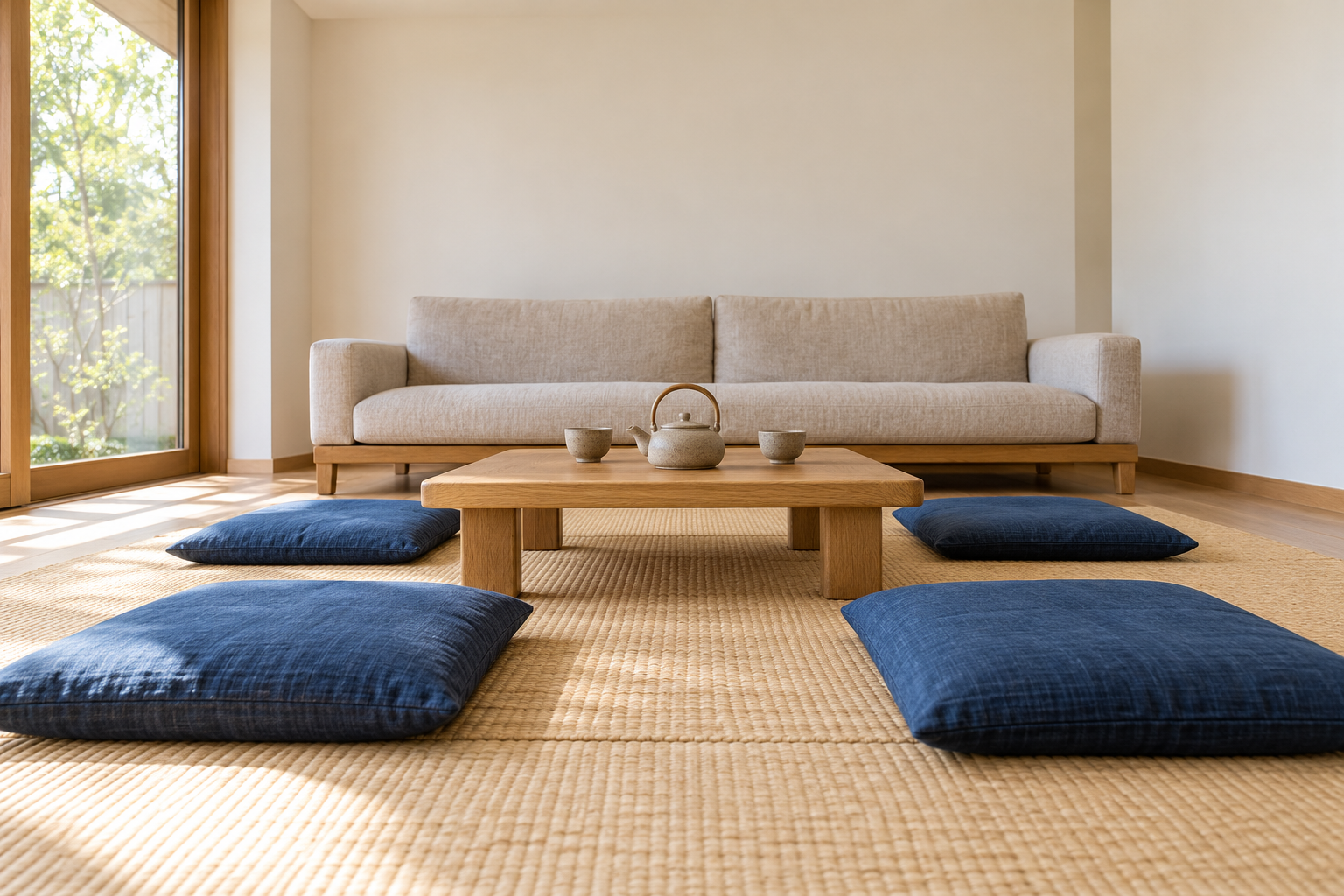
Flat, firm floor cushions, called zabuton in Japan, around a coffee table low enough to eat from make it a second place to sit, for tea, a board game, or dinner on the floor. In indigo-dyed cotton they bring a color with a long history on Japanese cloth, and a strong color among the neutrals.
The table needs to be low, around 12 to 14 inches, so someone sitting cross-legged on a cushion can use it. The cushions stack against a wall or slide under the sofa when they aren’t in use.
An Alcove for One Object
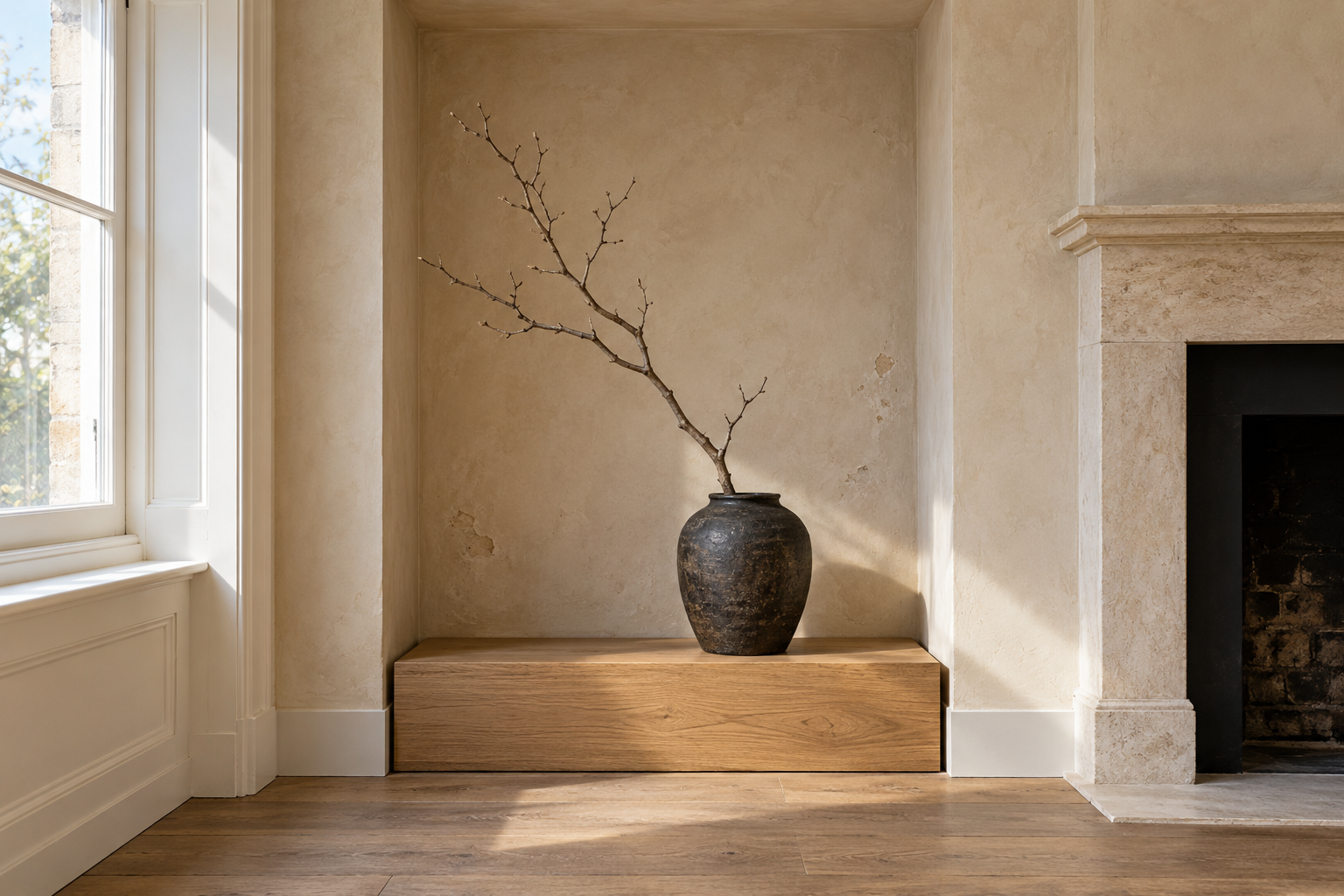
A traditional Japanese room has a tokonoma, a shallow alcove where one object, a scroll, a flower arrangement, a single pot, is displayed at a time and changed with the season. A living room can borrow the idea from a recess beside a chimney breast or a niche set into a wall.
Put one thing in it, a branch in a heavy stoneware vessel, a bowl, a small painting, and let daylight or a small lamp reach it from the side. Swapping it a few times a year, a branch of autumn leaves for a bare winter one, changes the room without adding anything to it.