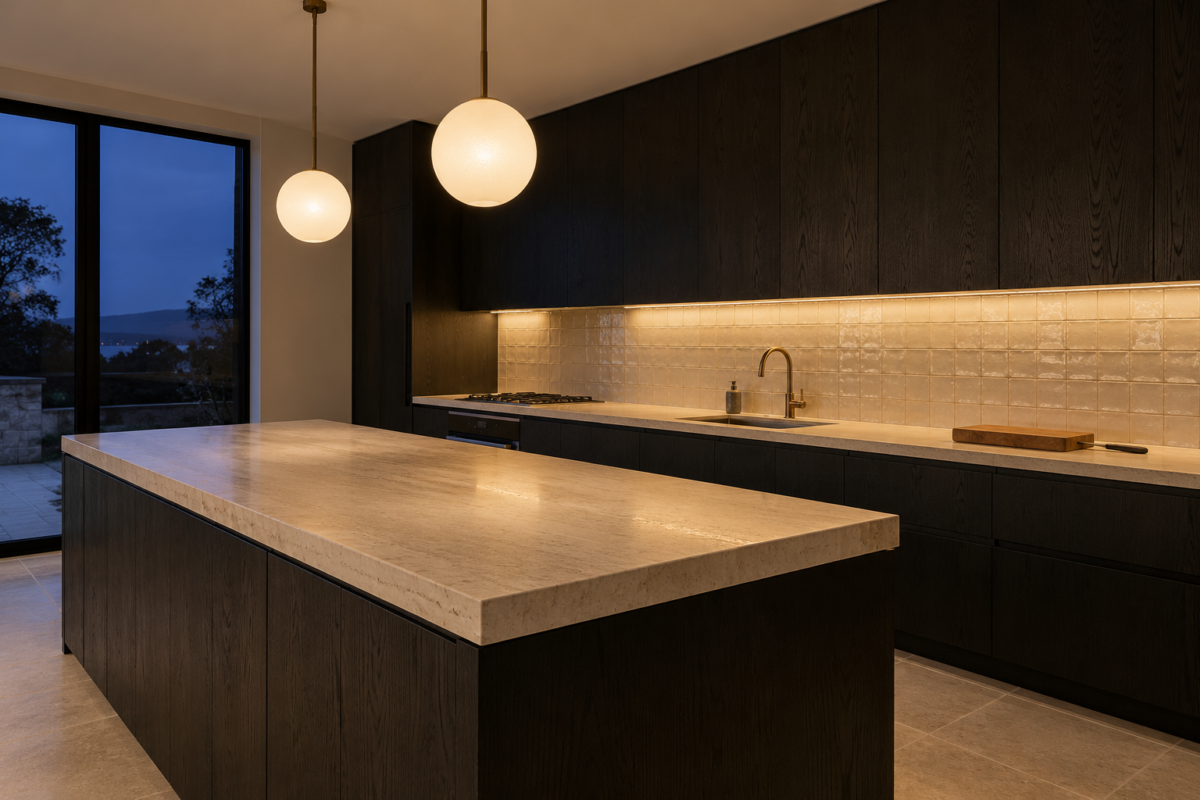
The light a kitchen uses most is one nobody looks at. It sits under the wall cabinets, a foot and a half above a counter two feet deep, and it lights the board, the knife, and the hands, close up and from in front, where a fitting in the middle of the ceiling would light them from behind the cook.
A kitchen is also the most reflective room in the house. Stone, steel, glazed tile, lacquer, and glass show the source of the light as well as the light itself, a row of bright dots in a polished counter, a pendant doubled in a black window, a band of glare across a glossy door. So where a fitting sits, and what it shines on, counts for as much as how bright it is. The ideas start at the counter, with the light closest to the work.
Put the Strip Near the Front of the Cabinet
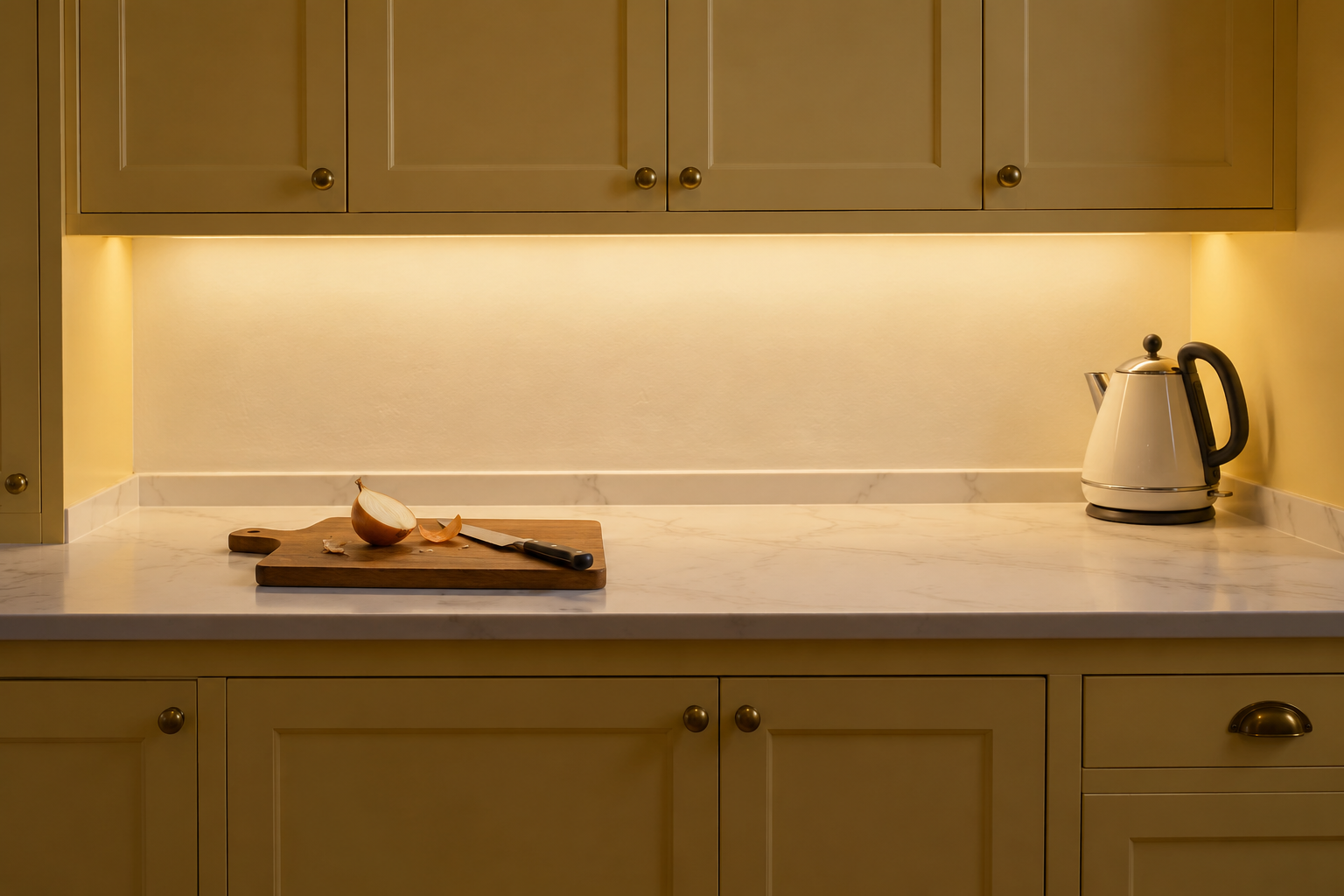
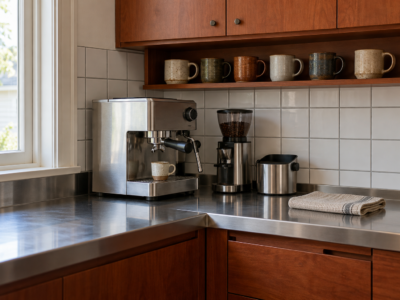
Light under the wall cabinets is the light a kitchen uses most, and where the strip sits under the cabinet decides what it lights. Fixed at the back, against the wall, it makes a bright band on the backsplash and leaves the front of the counter, where the board sits, noticeably dimmer. Fixed a couple of inches behind the cabinet’s front edge, it spreads over the whole depth of the counter.
A small wooden lip along the bottom of the cabinet hides the strip from anyone standing. On a polished counter, choose a strip behind a frosted cover. Bare points of light show up in quartz or stone as a row of bright dots.
Choose a Backsplash That Gives the Light Back
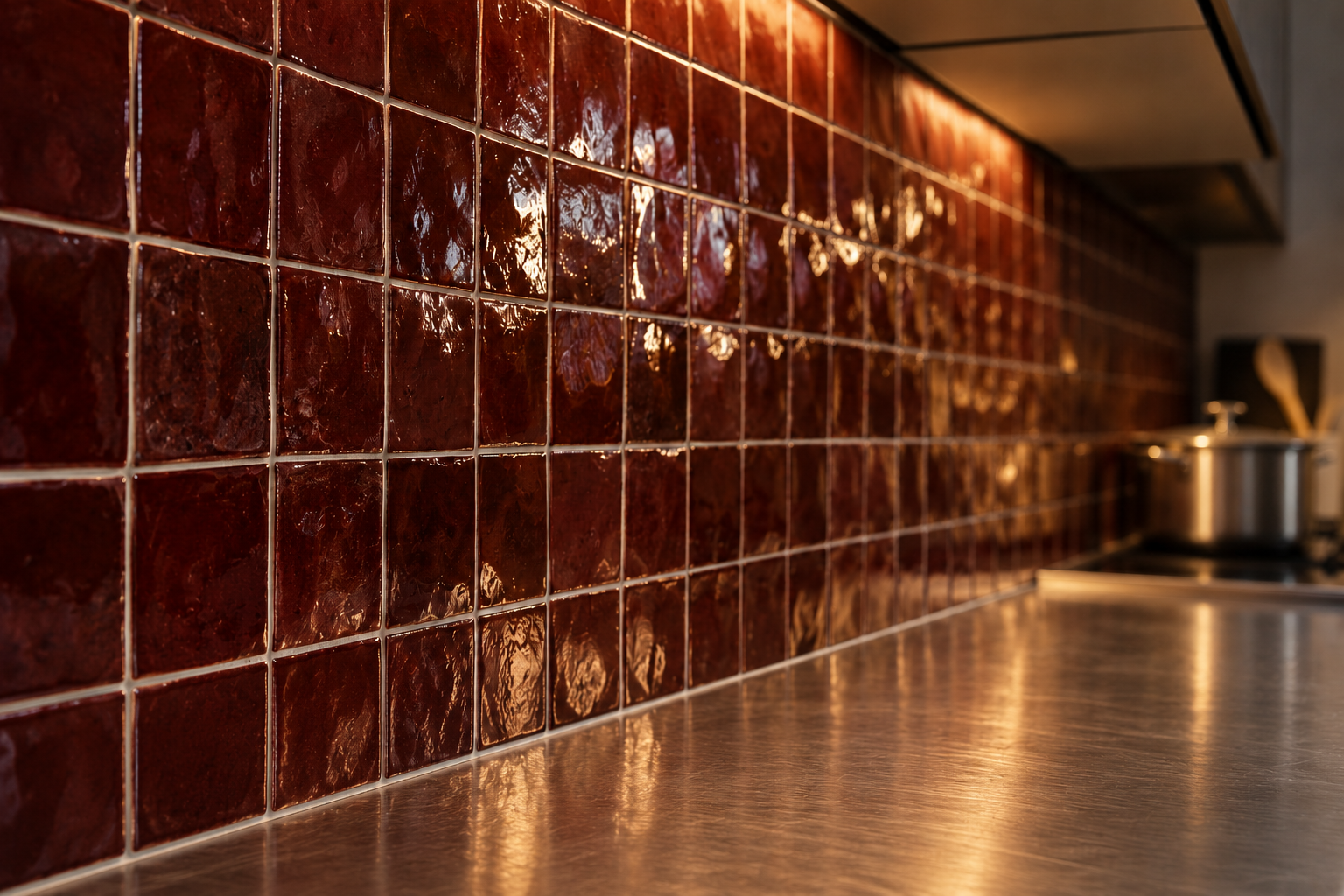
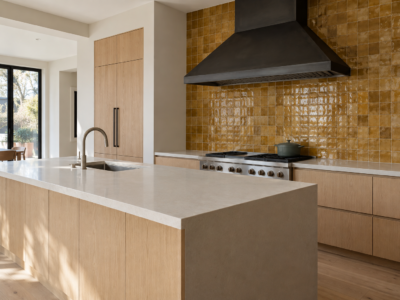
The strip lights the wall behind the counter as much as the counter, so the wall’s finish matters. Handmade glazed tile is never quite flat. Each tile sits at its own slight angle, and under a light from above each one holds its own small highlight, so the wall shimmers when the strip is on and goes still when it’s off. A honed stone or a matte tile takes the same light evenly and softly, with no sparkle.
Gloss shows the light source as well as the light, which is one more reason to keep the strip behind a cover. In a dark color the effect is strongest, since the highlights stand out against the glaze. Oxblood, deep green, and inky blue all do it well, and handmade tile in any of them changes through the evening.
Light Open Shelves From Underneath
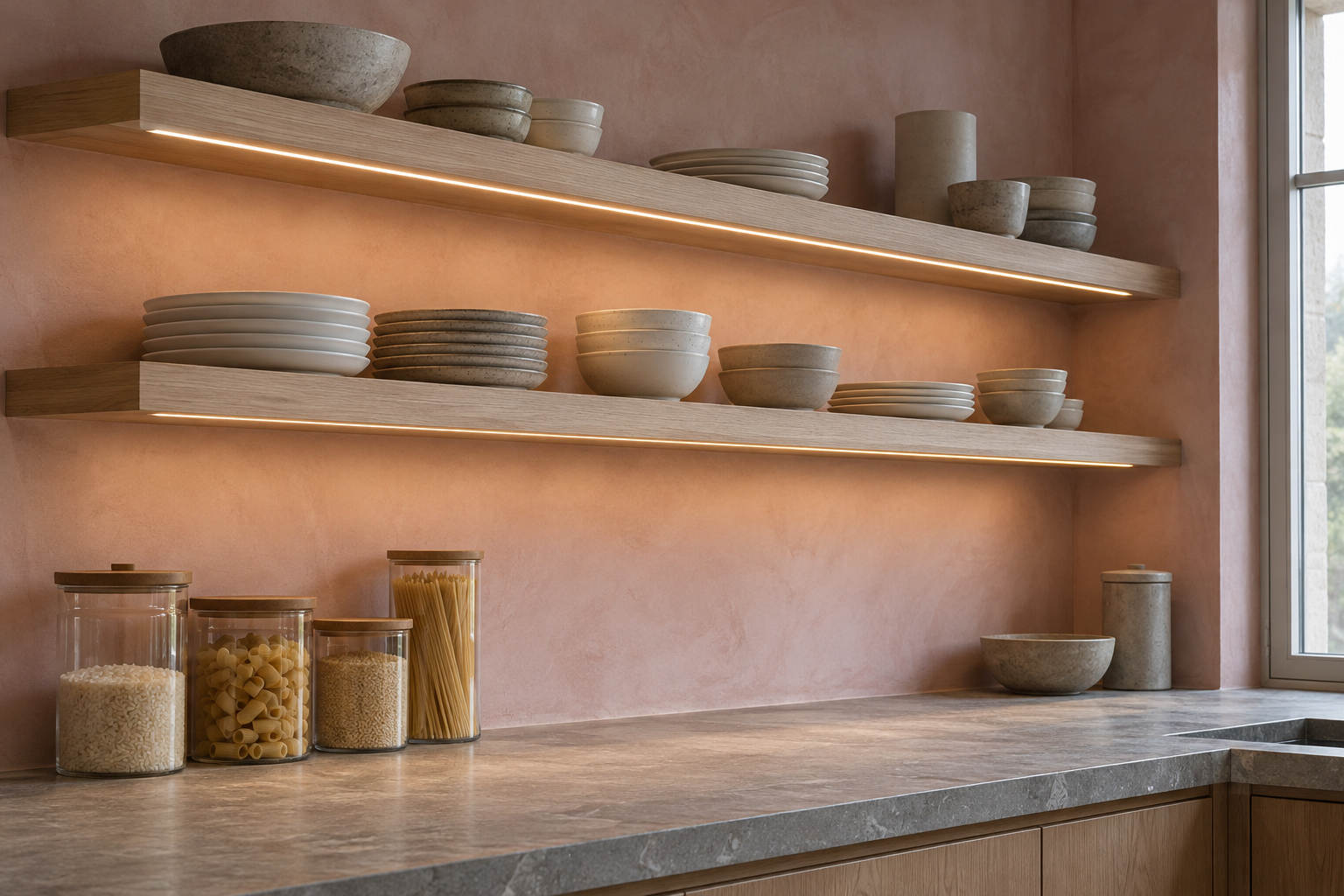
Where open shelves take the place of wall cabinets, the light can go into the shelves themselves. A thin strip set into a groove under each shelf, near its front edge, lights the plates on the shelf below, and the lowest shelf lights the counter the way a cabinet would.
Thickness makes it possible. A shelf 2 inches thick hides the strip in its underside. A thin one shows it, and a strip stuck to a thin shelf looks added afterward. The cable is the other thing to decide before the shelves go up, since it has to run inside the wall or through the bracket, and it can’t be hidden once the plaster is finished.
Hang Sconces on Arms Where There Are No Wall Cabinets
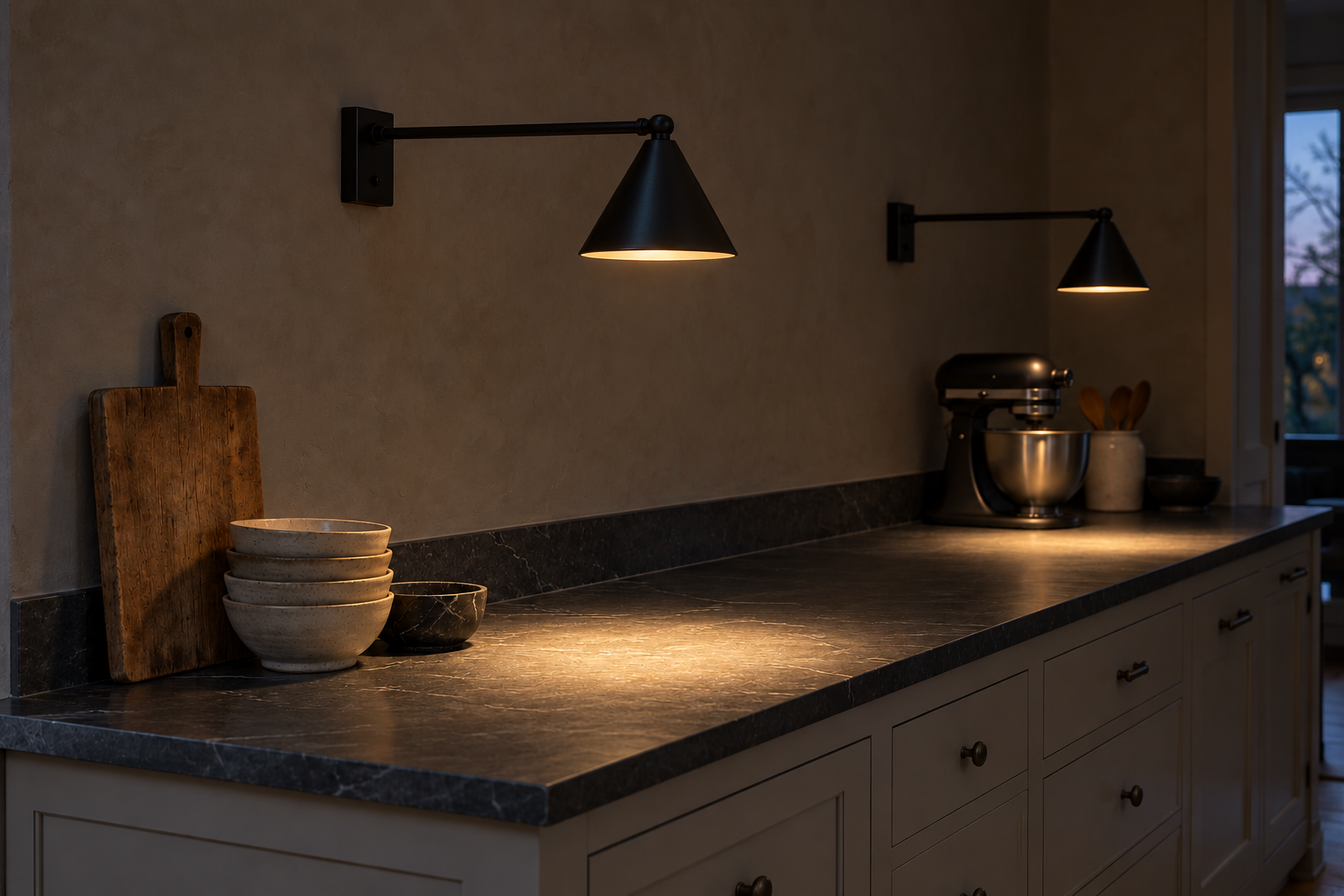
A counter under a window, or along a wall kept free of cabinets, has nothing to hang a strip from. Wall lights on arms reach out over it. Swung forward, the shade sits over the front half of the counter, close to the work, and pushed back it clears the wall when the counter is wiped down.
Set them by what is used there. The bottom of each shade should clear the tallest thing that stands on that counter, a mixer, a stock pot, the kettle being filled, and stay low enough that the bulb is hidden from someone standing. Sconces that plug in, with the cord run down the wall in a painted cover, suit a wall that can’t be opened for wiring.
A Lamp at the End of the Counter
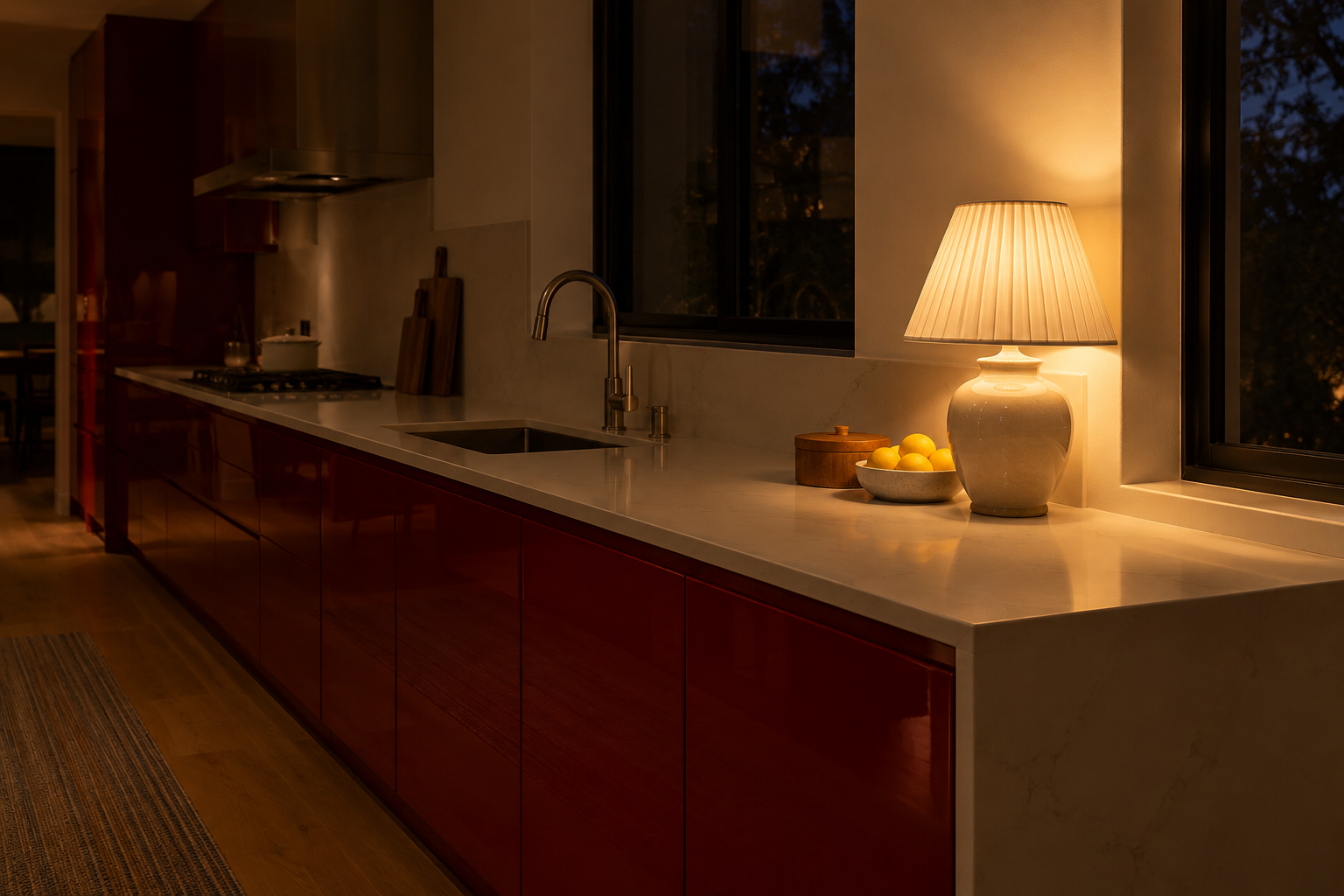
A table lamp at the end of a counter, against the wall, gives a kitchen a light that sits low and comes from the side. With everything else off, it lights a corner for a late cup of tea or a conversation after dinner, and the rest of the room drops back into shadow.
Pleated linen or paper turns the bulb into a soft glow and lights the wall behind as well as the counter. Glass or metal throws a sharper pool. Keep the lamp well away from the sink and the hob, at the end of the counter where nothing is chopped or poured, and give it a heavy base that won’t tip when a pan is set down nearby. A rechargeable lamp leaves no cord across the counter.
Hang a Light in Front of the Sink Window
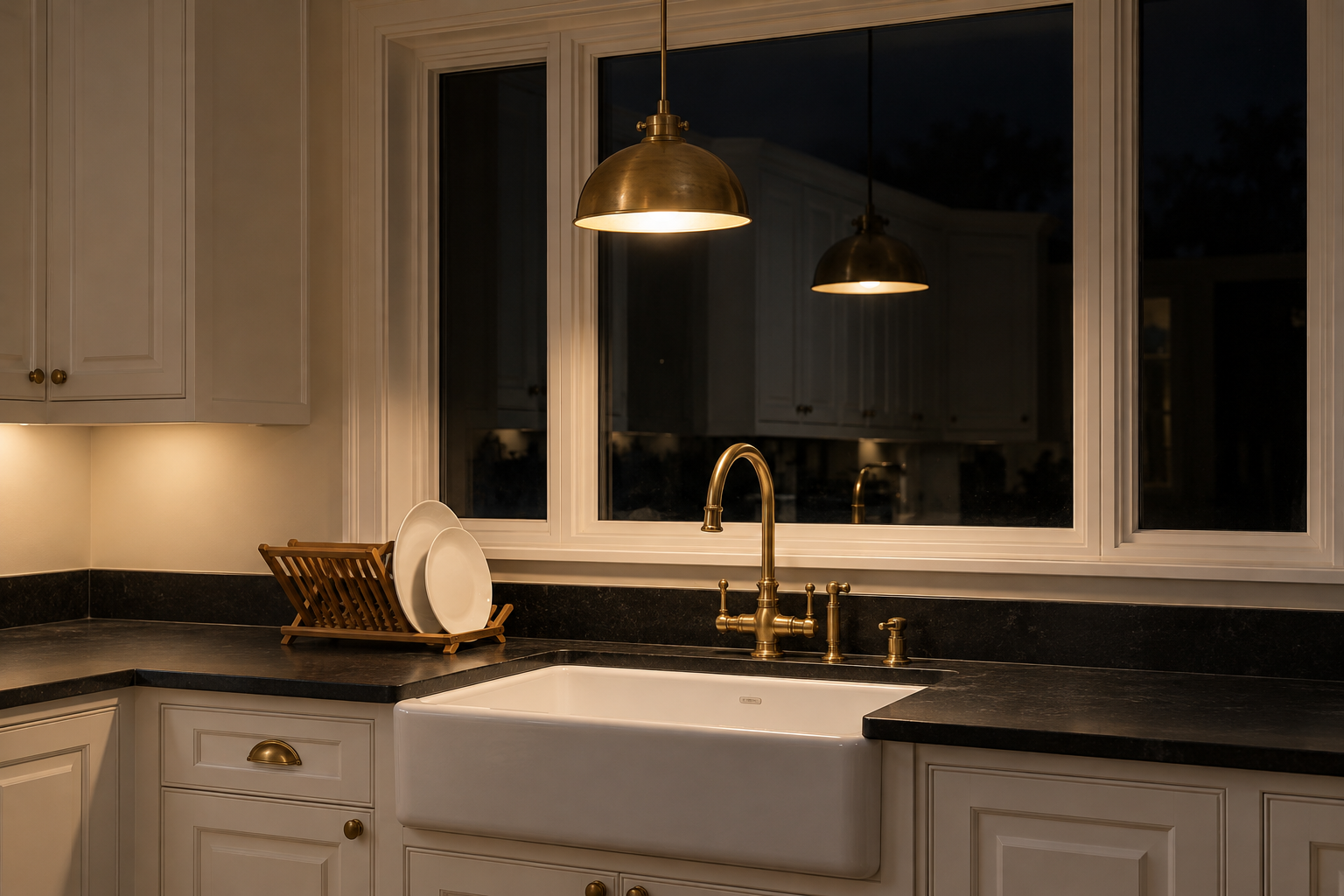
The sink usually sits under a window, with no wall cabinet above it, and that patch of counter is lit by daylight and nothing else. A single small pendant hung just in front of the glass, centered on the sink, puts light into the basin and onto the draining board.
At night the window turns black and reflects the room. A pendant in front of it appears twice, the fitting and its reflection, a second glowing shade floating outside. Some people like the effect. Where it would be a distraction, a downlight set into the ceiling above the sink or a sconce on the wall beside the window lights the basin and leaves less to reflect.
Frame the Range Hood With Two Sconces
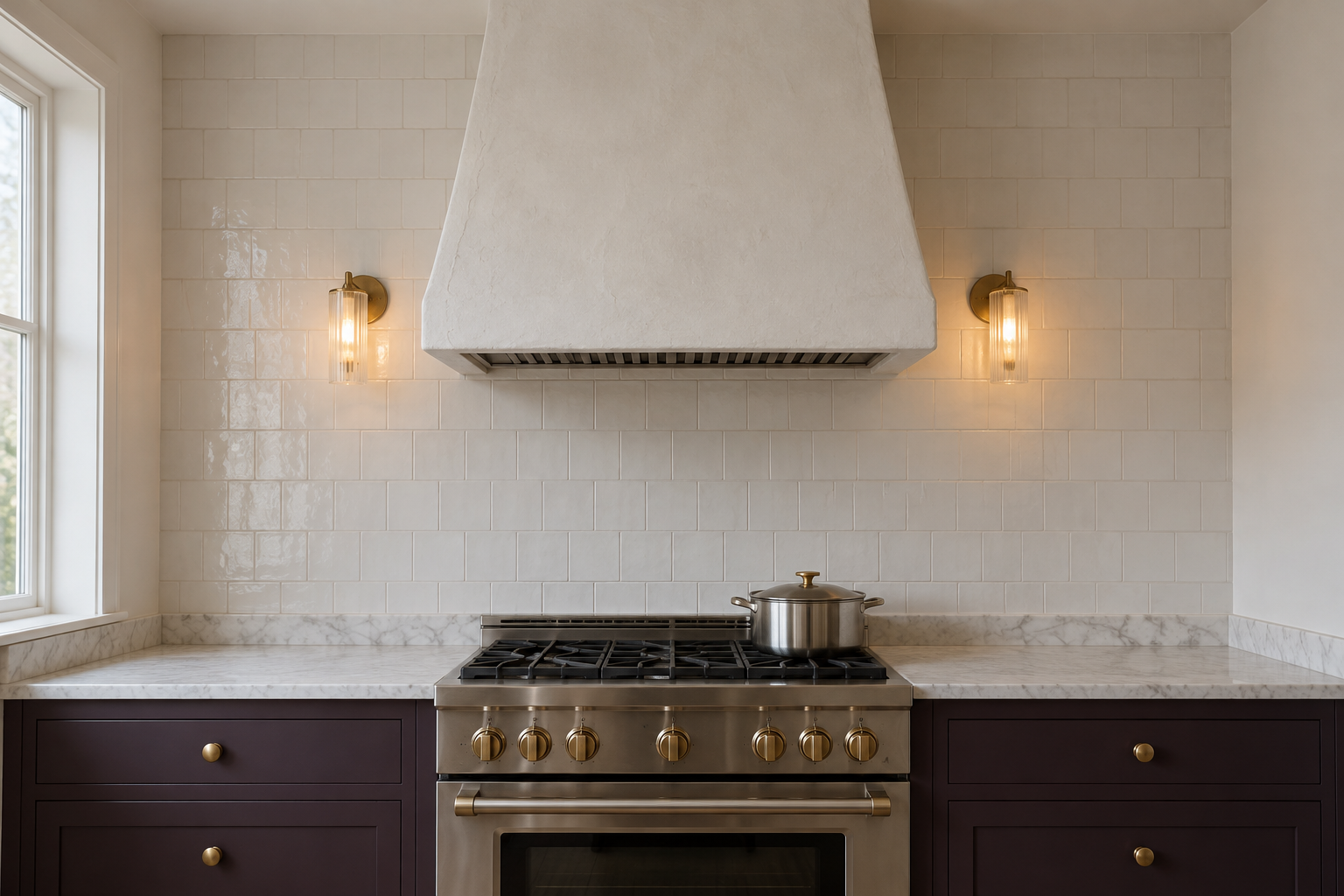
A hood that runs up to the ceiling usually has bare wall on each side and no cabinets to hang light from. A matching pair of wall lights, one each side, lights the edges of the cooktop where the hood’s own light doesn’t reach. They also give the cooking wall an even, symmetrical frame, which suits a plaster or tiled hood with a strong shape.
Keep them a few inches outside the hood’s width, where less steam and spatter reach them, and choose shades that can be wiped: glass, metal, ceramic. Fabric over a stove ends up sticky. Ribbed or frosted glass hides the bulb, which matters at this height, since the lights sit close to eye level for someone at the stove.
Glass Cabinets Lit From Inside
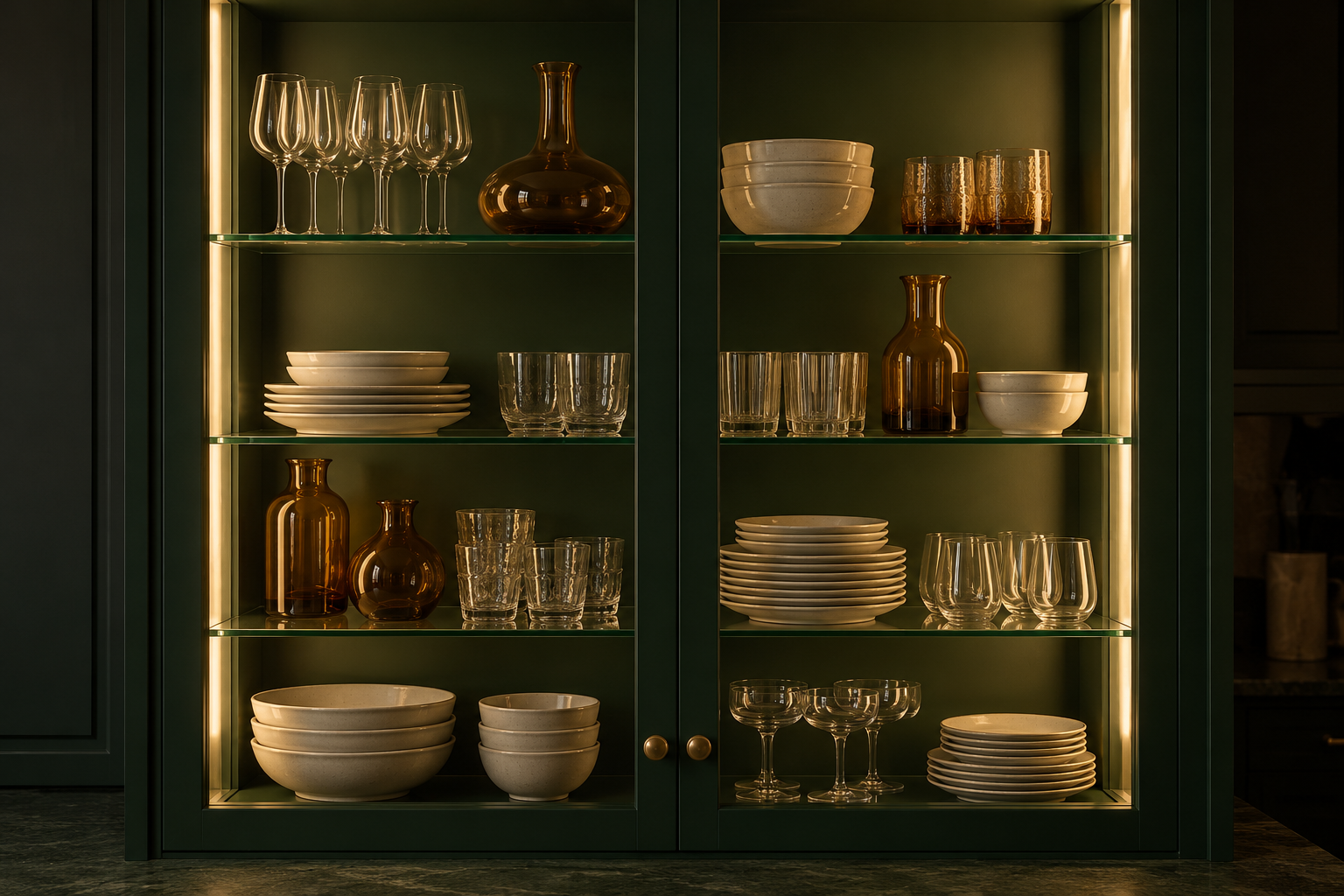
Doors of glass show what’s behind them, and at night a lit cabinet becomes the brightest thing in a dark kitchen. Light fixed down the inside of the cabinet’s sides, behind the door frames, reaches every shelf when the shelves are glass, because the light passes through them. Wooden shelves stop it, and then each shelf needs its own light under its front edge.
What’s inside changes the effect. White stoneware takes the light and glows evenly. Clear glass and amber glass catch it and throw it back in points. A cabinet painted a deep color, forest green or a dark blue, makes the lit interior look brighter by contrast, the same way a lit window looks brighter from a dark street.
Wash the Ceiling From the Top of the Cabinets
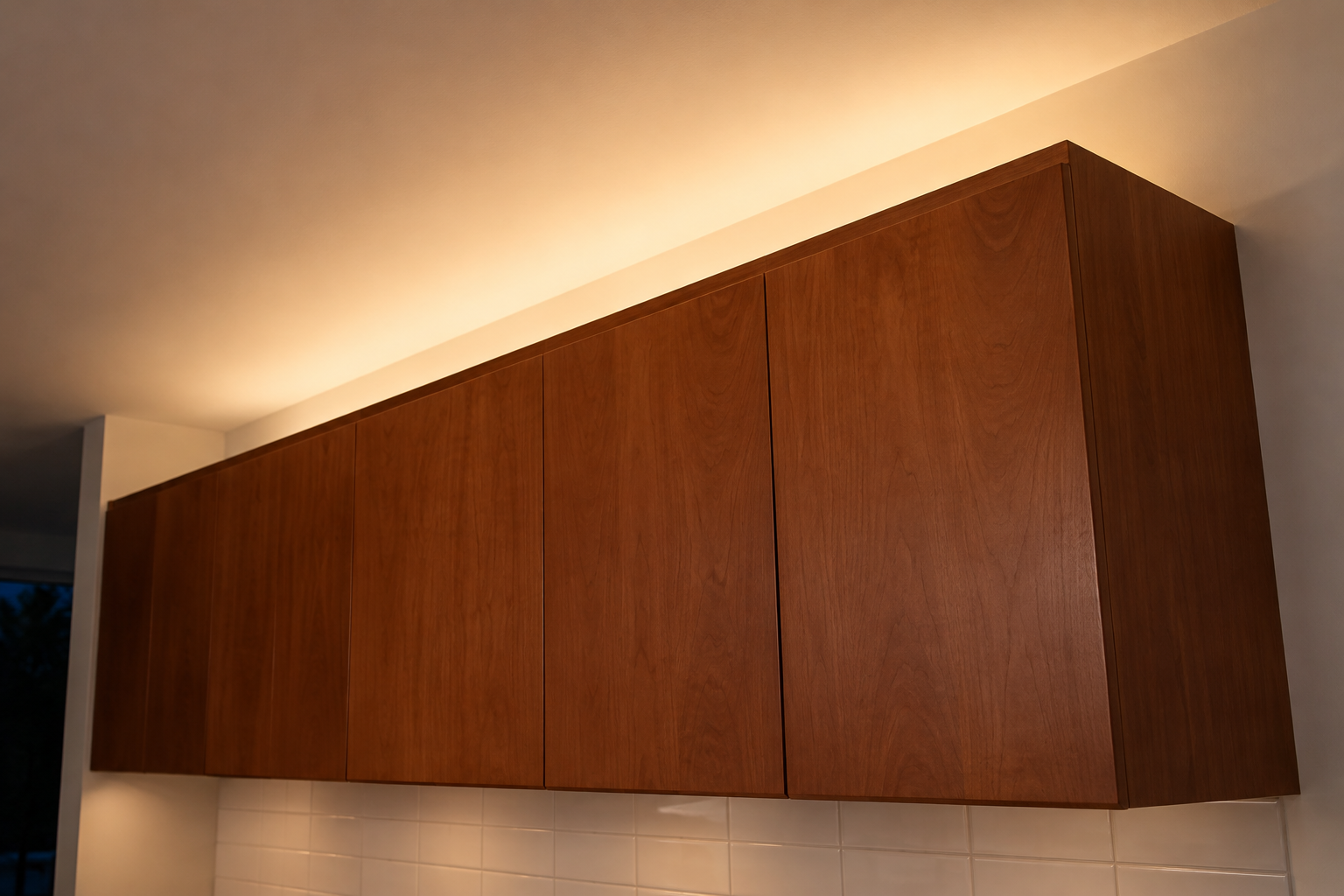
Wall cabinets that stop short of the ceiling leave a gap that usually collects dust and a few rarely used platters. A strip laid on top of the cabinets, facing up and hidden behind a lip, washes the ceiling with light. In the evening that gives the room a soft overall brightness without any fitting in view.
How even the wash looks depends on the gap. With a foot or more between the cabinet and the ceiling, the light has room to spread across the ceiling and fade gently into the room. With only a few inches, it tends to land in a bright stripe close to the cabinets. The top of the cabinets also has to stay clear, since anything standing there throws its shadow across the ceiling.
Match the Island Pendants to the Island’s Length
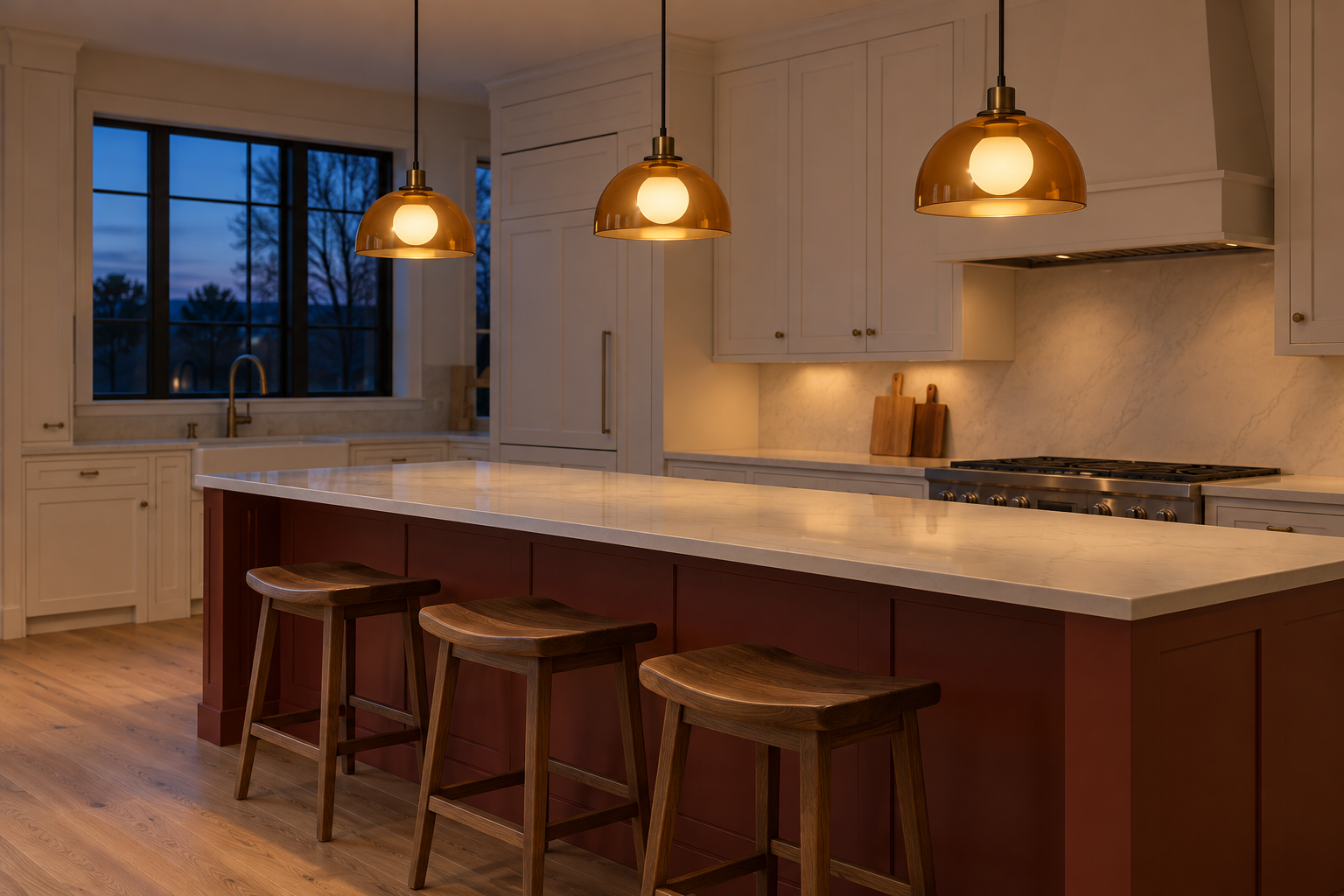
The number of pendants follows the island’s length. Under 5 feet, one or two. Six to 7 feet, two or three. Eight feet and longer, three, spaced evenly, with at least as much air between them as each shade is wide, and never less than about 18 inches. The bottom of each shade sits 30 to 36 inches above the counter, low enough to light the work and high enough to see across.
The shade changes what the island looks like at night. Opal glass glows all over and lights the ceiling a little as well as the counter. A metal dome throws all its light down, so the counter is bright and the space above the pendants stays dark. Tinted glass, amber or smoke, colors the light that reaches the counter, which is pleasant for eating and less useful for judging whether the onions are done.
One Long Pendant for a Long Island
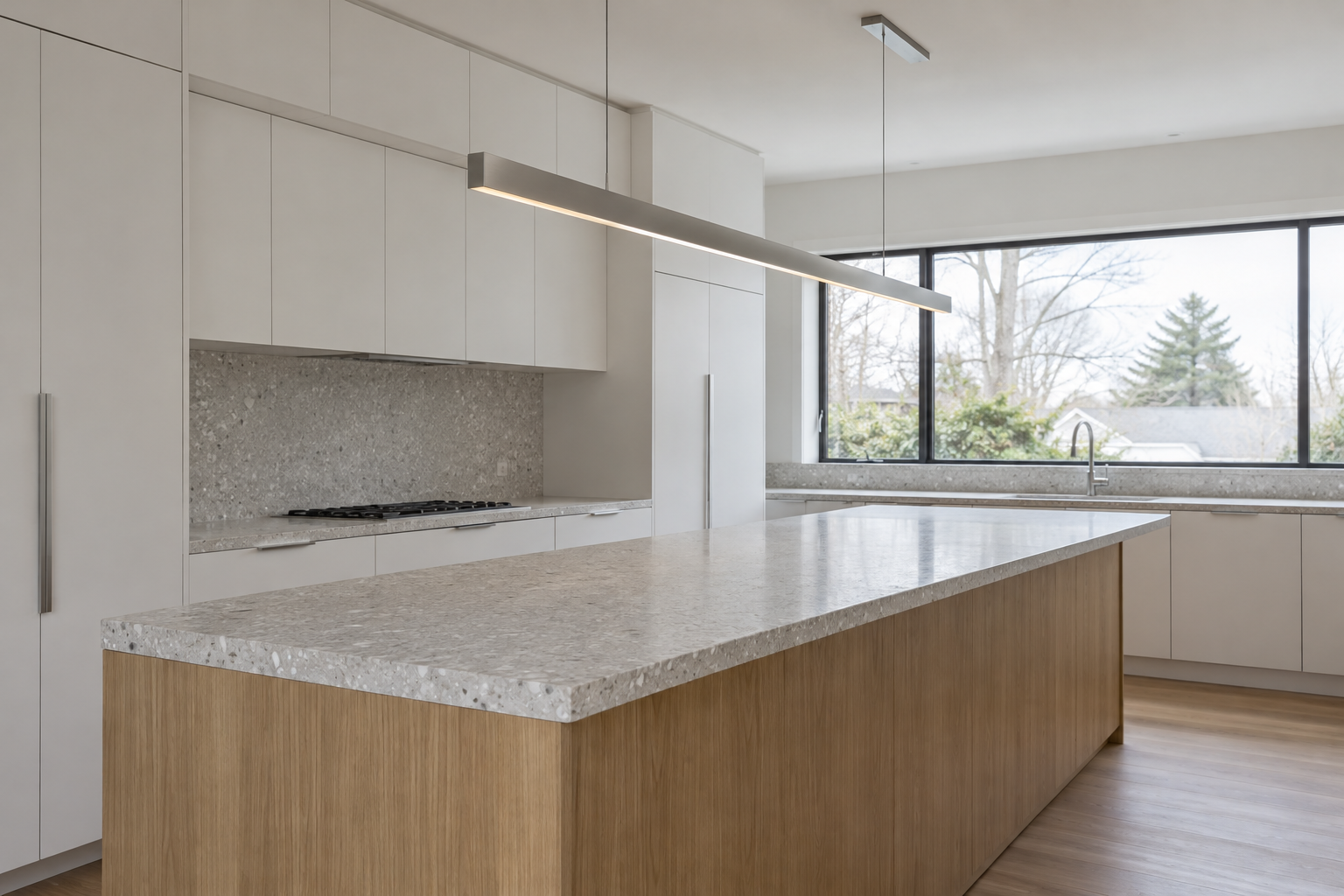
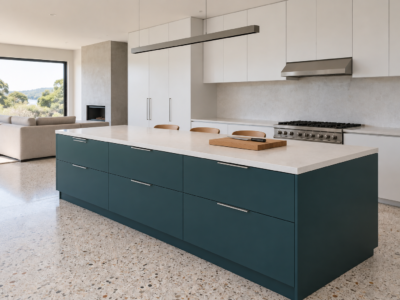
A single linear pendant hangs from one canopy and draws one line along the island instead of a row of separate shapes. On a long island it spreads its light evenly from one end to the other, and the ceiling above the island carries a single canopy instead of a row of them.
It should stop clearly short of the island’s ends, so a foot or two of counter runs past each end. The ends of the island are where people sit and stand, and a fitting that reaches the edge sits right above their heads. A slim one, only a few inches tall, keeps the view across the kitchen open.
Line the Downlights Up With the Counter Edge
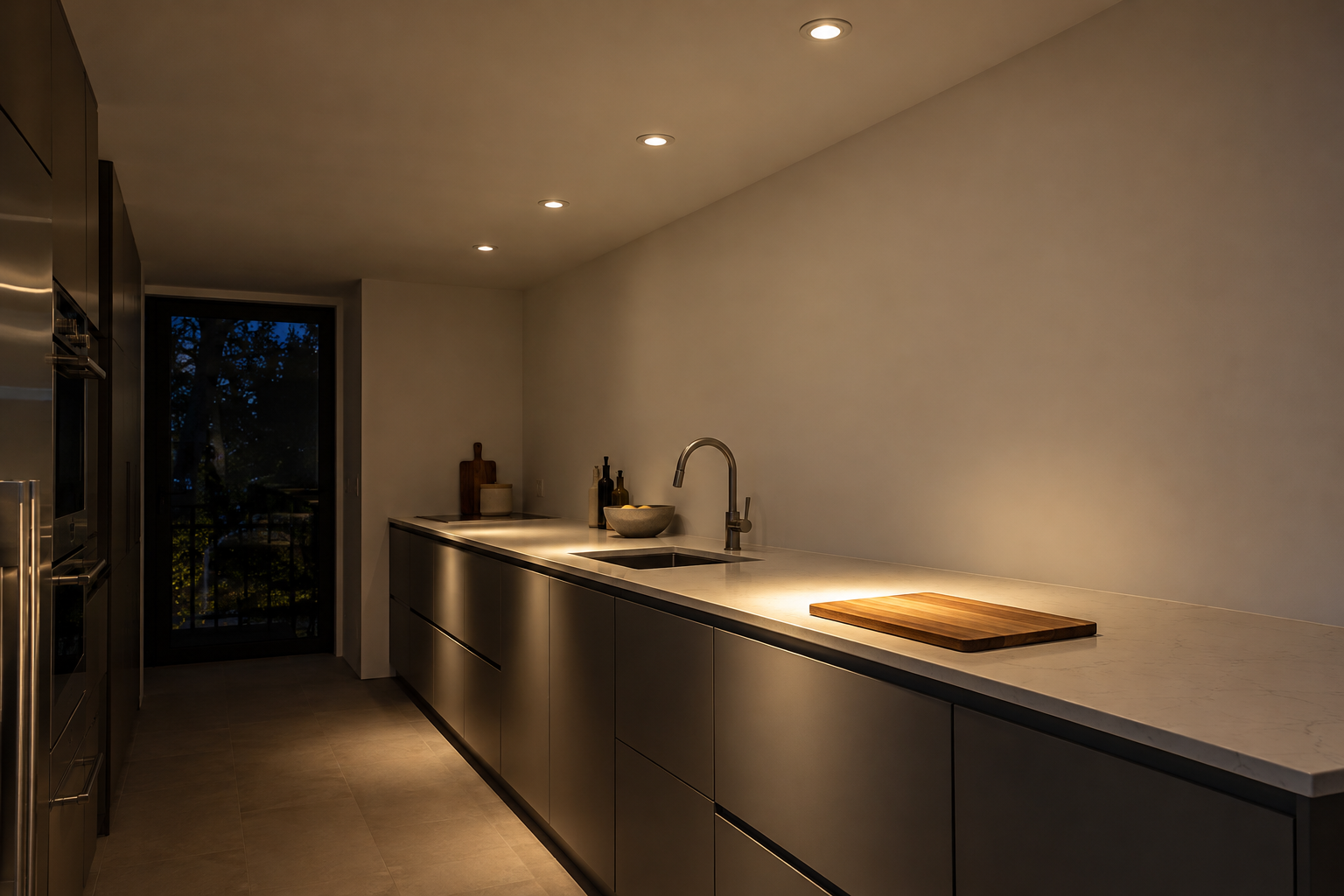
Downlights laid out in a grid across a kitchen ceiling put some of their light on the floor of the aisle and some behind the cook, who then stands in their own shadow. Lined up above the counter, they light the work. Centered over the front edge of the counter, about 24 inches out from the wall behind it, each one shines down just in front of the person standing there.
The ceiling then follows the plan of the kitchen, with lines of lights tracing the counters, and the aisle sits in the softer light between them. Where wall cabinets run above the counter, the same line of lights falls a little in front of their doors, which lights the cabinet fronts as well.
Turn One Ceiling Box Into a Track
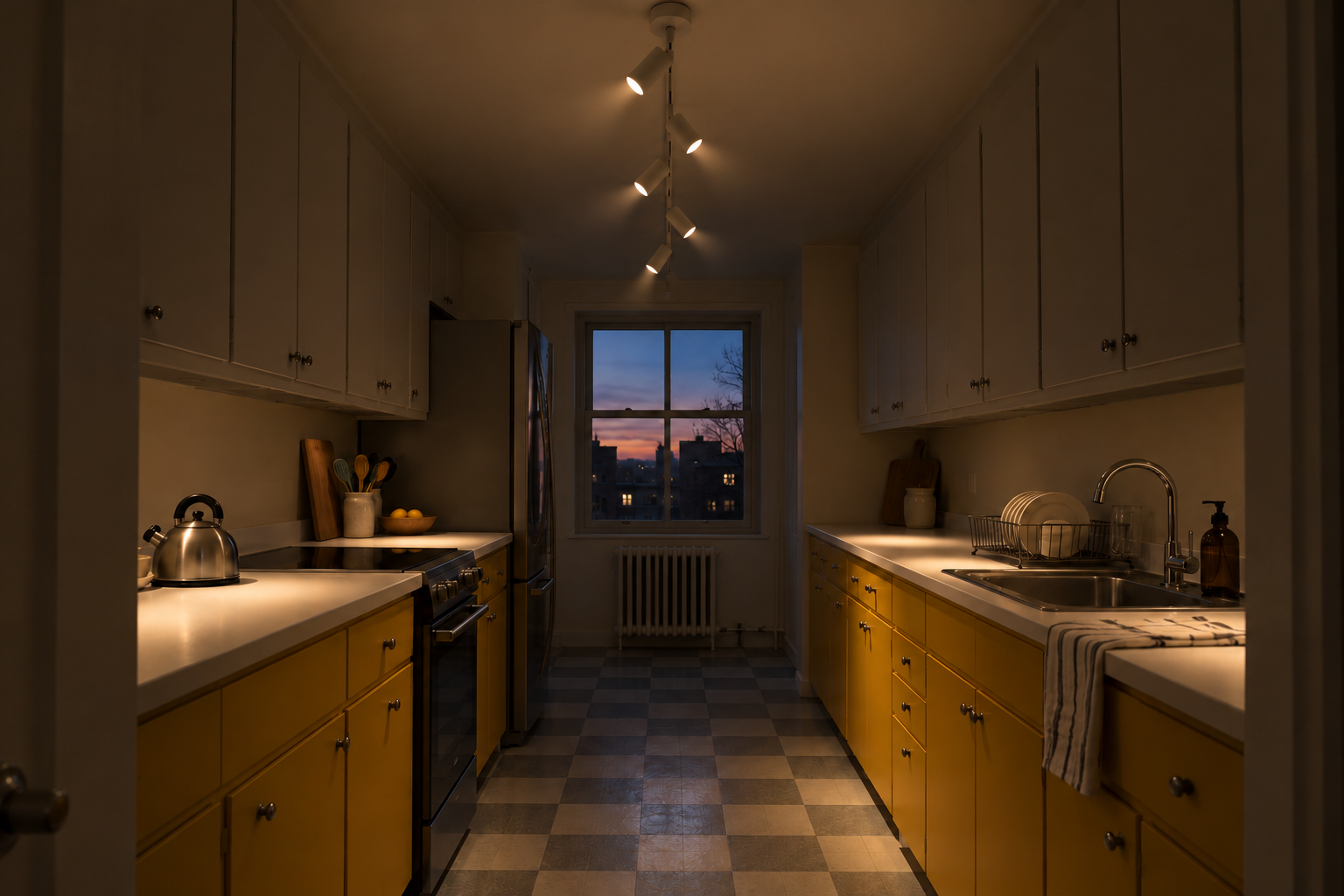
Many older kitchens have one electrical box in the middle of the ceiling and a single fitting on it. A track run from that box carries several small heads, and each can be turned to point at a counter, the sink, or the table. In a galley, one straight track down the center can light both counters at once, with half the heads aimed each way.
A track can usually be fed from the box that’s already there, so the ceiling doesn’t have to be opened along its length. A slim white track on a white ceiling almost disappears in daylight. Point every head at a surface and none at the floor, and keep them high enough that none of them shines into the eyes of someone walking down the room.
A Wide Flush Light for a Low Ceiling
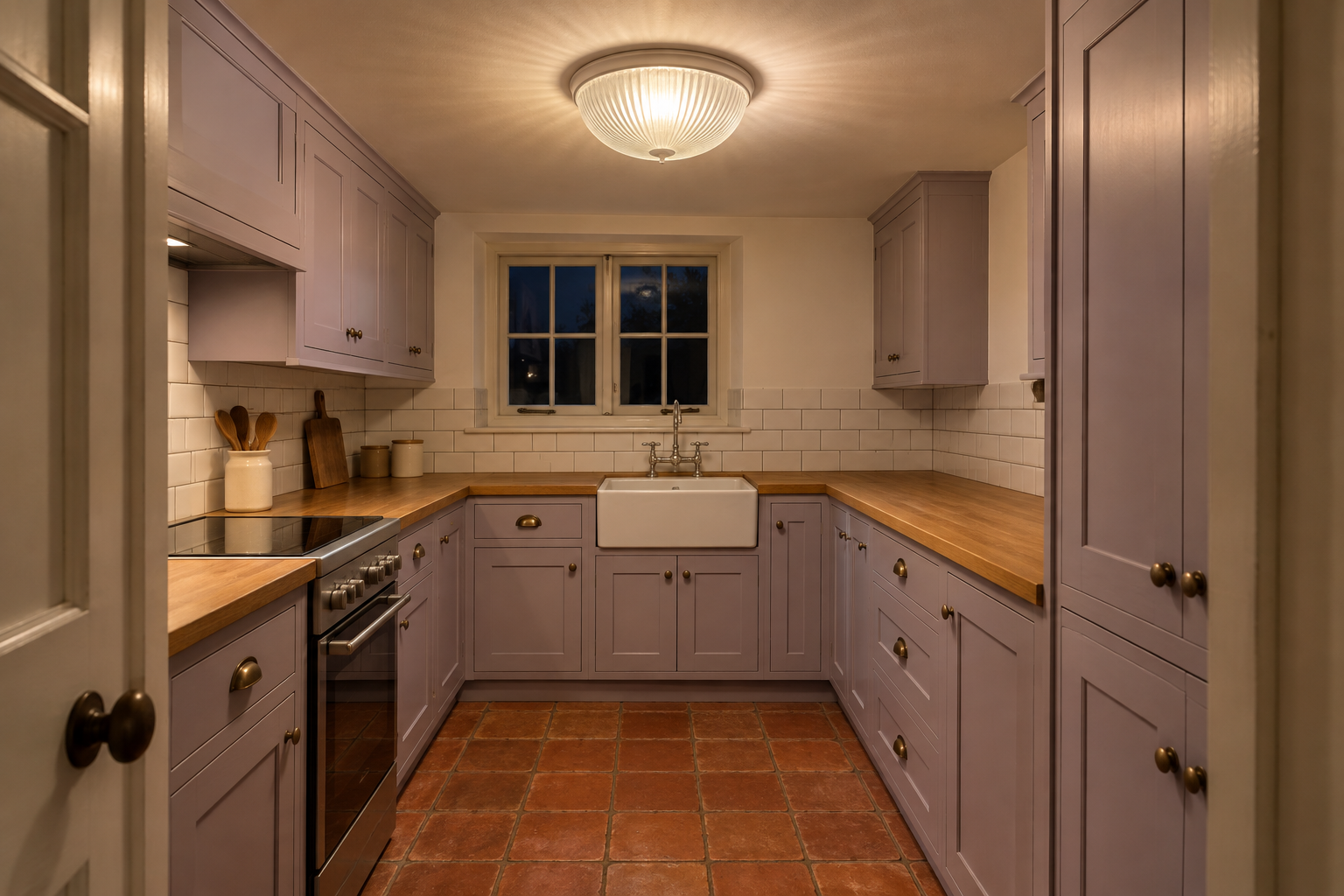
Under a ceiling below 8 feet, a pendant over the middle of the kitchen hangs into the walkway. A wide flush light, fixed tight to the ceiling, takes its place and can still carry the room. Ribbed glass breaks the light into bright lines that show on the shade itself. Opal glass glows evenly. A pleated fabric drum is softer still.
Size matters more than it seems in a small room. A fitting a foot and a half or more across tends to spread its light toward the walls and onto the ceiling, so the room looks evenly lit, where a small one makes a bright spot in the middle and leaves the corners dim. On its own it won’t light a counter well, so pair it with strips under the cabinets.
Give the Kitchen Table Its Own Light
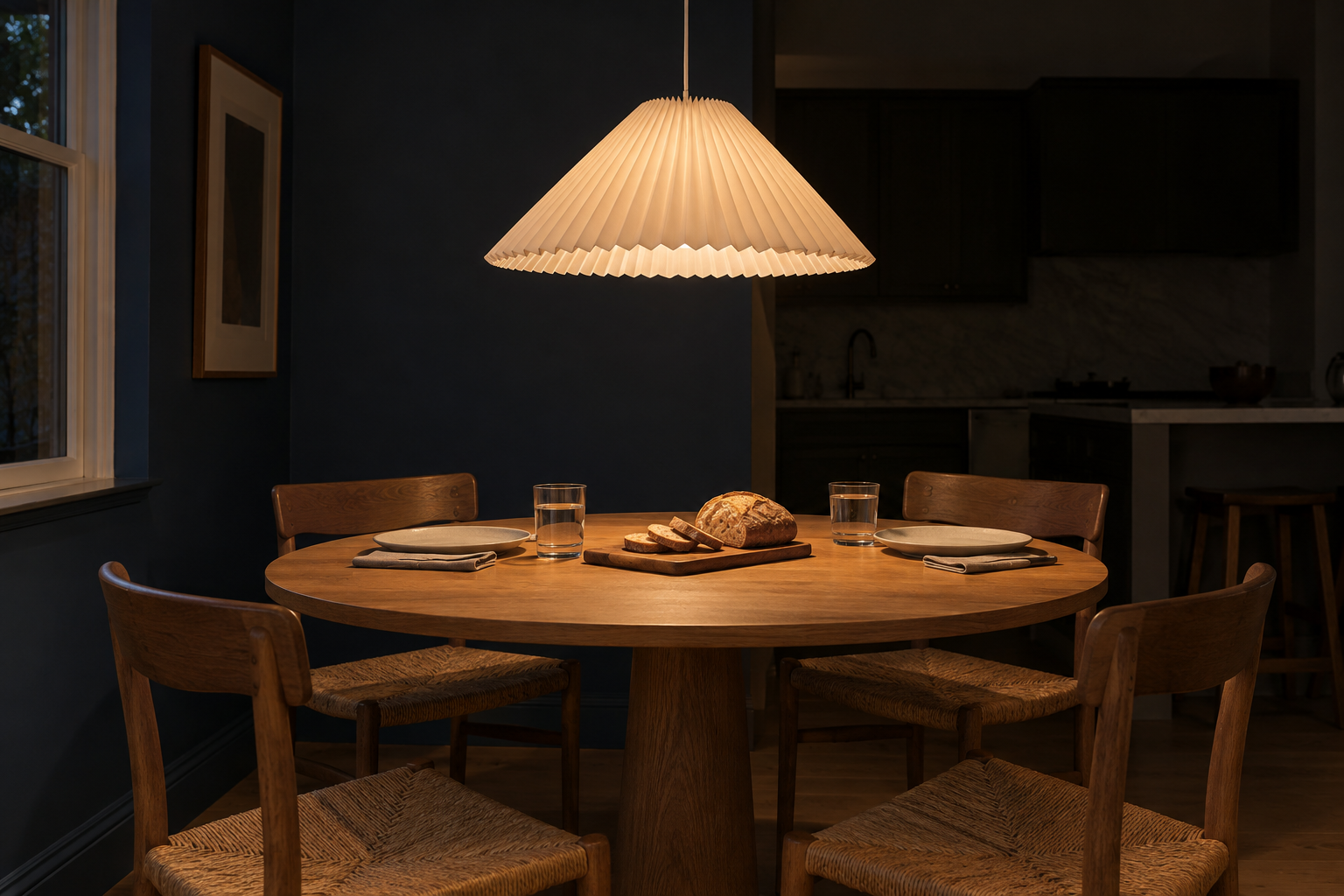
A table in the kitchen needs light of its own, on its own switch, so dinner can happen with the work lights off. A pendant centered over the table, with its bottom 30 to 36 inches above the top, lights the plates and faces and leaves the counters in shadow, which hides the pans waiting to be washed.
Center it on the table, not on the room. Where the box in the ceiling isn’t above the table, the cable can be carried across to a hook above it. A dimmer helps more here than anywhere else in the kitchen. Full brightness suits homework and bill paying, and a much lower setting suits the end of a meal.
Put a Wall Light Over the Banquette
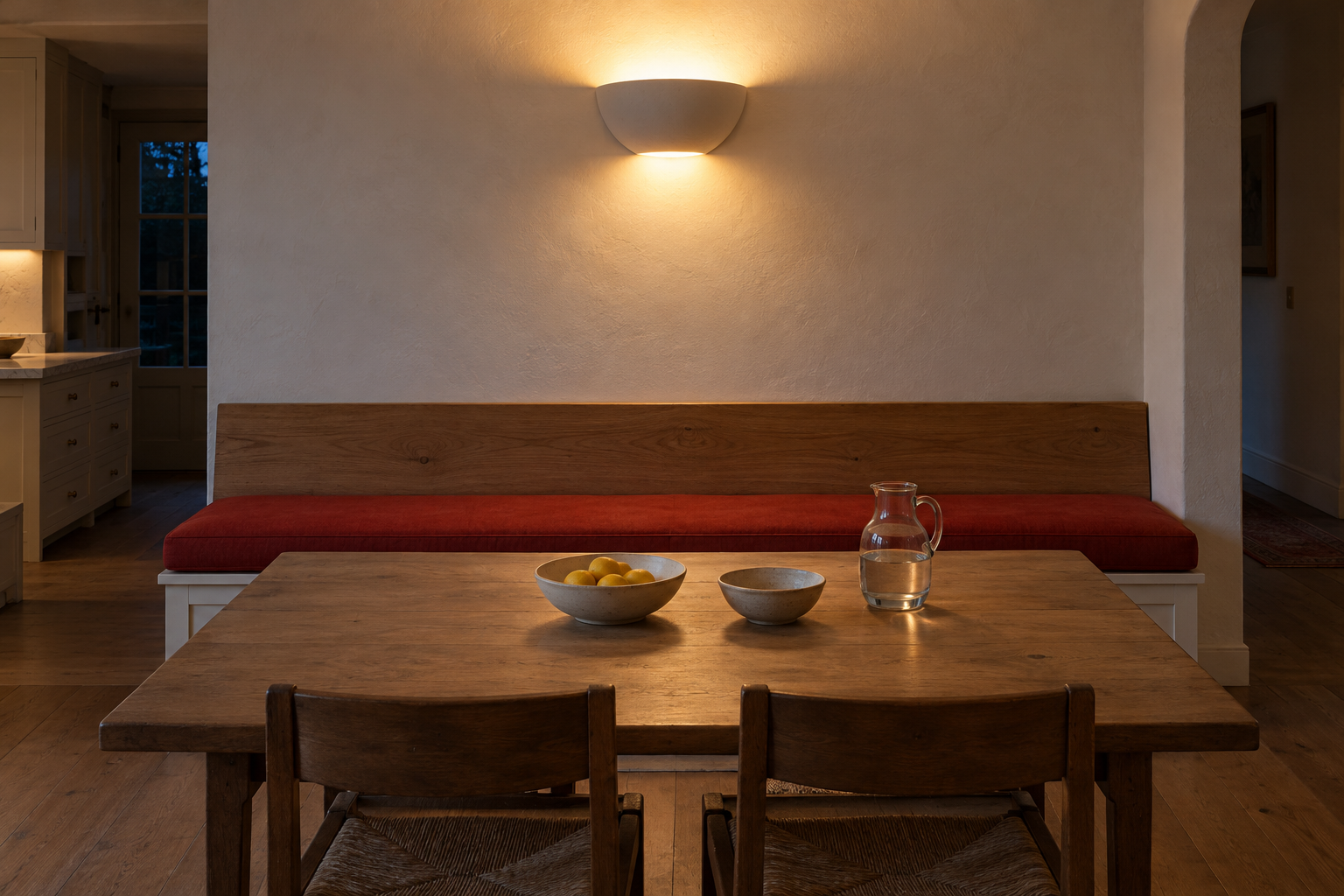
A bench built against the wall leaves no room for a floor lamp and often sits off center from any ceiling box. A wall light above the bench fills that gap. Its shade has to sit above the heads of the people sitting there, so mount it from the top of the bench back up, not from the floor, and hold a paper template in place with someone seated before fixing it.
A shade open at the top, or a plaster bowl, lights the wall above as well as the table, and a lit wall tends to make a corner feel larger in the evening. One light centered on a short bench does the job. A long banquette that wraps a corner may need two.
Light the Toe Kick for the Night
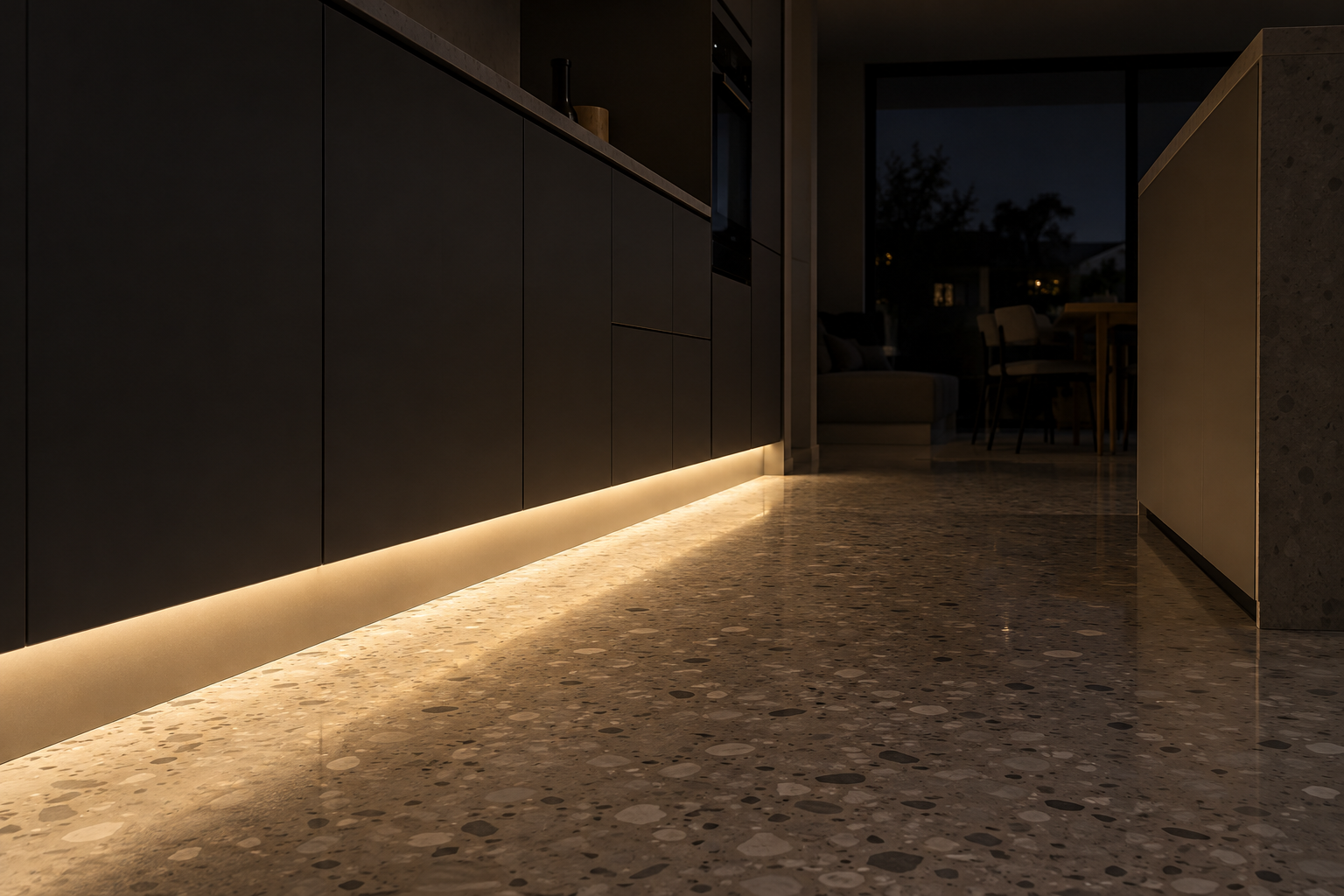
The recess under the base cabinets, where the toes go, can hold a strip of light that shines onto the floor. At night it gives enough light to cross the kitchen for a glass of water without switching on anything overhead, and eyes adjusted to the dark aren’t dazzled.
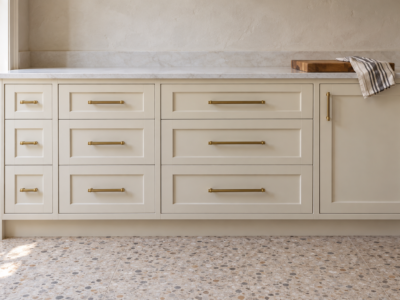
Polished terrazzo or glazed tile reflects the band and doubles it. Matte wood or cork takes it as a soft wash. It works best warm and dim, on a motion sensor or a separate switch so it can stay on through the night.
Let the Pantry Light Itself
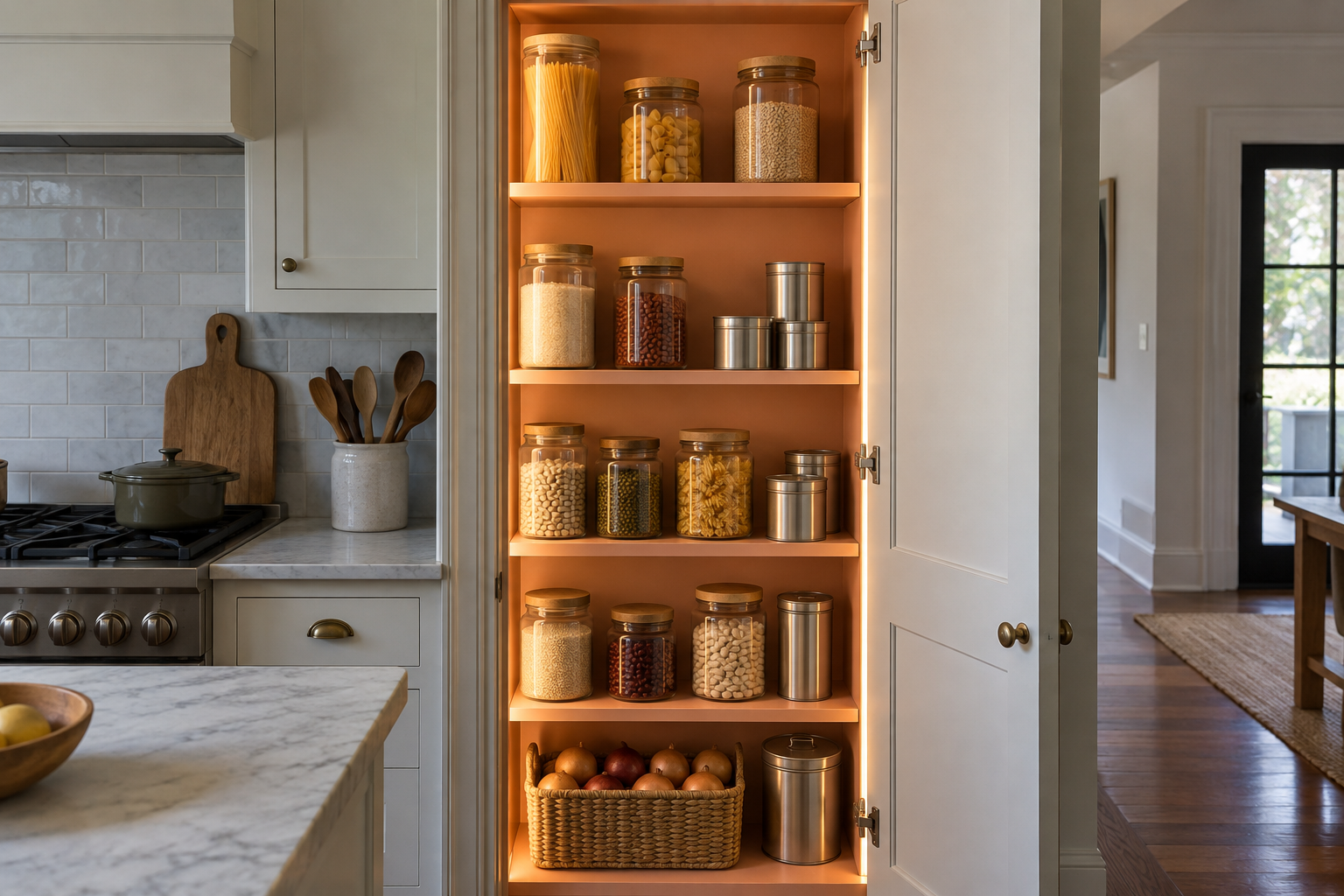
A deep cupboard is dark at the back, and nobody reaches for a switch to look for the rice. A light strip inside the cupboard, wired to a switch in the door frame or set off by a motion sensor, comes on when the door opens and goes off when it shuts. Run up the inside of the frame, it lights every shelf to the back. Rechargeable strips with their own sensors fit a cupboard that has no wiring at all.
The same idea works in deep drawers and in the corner cupboard where pans disappear.
Bring Daylight In From the Roof
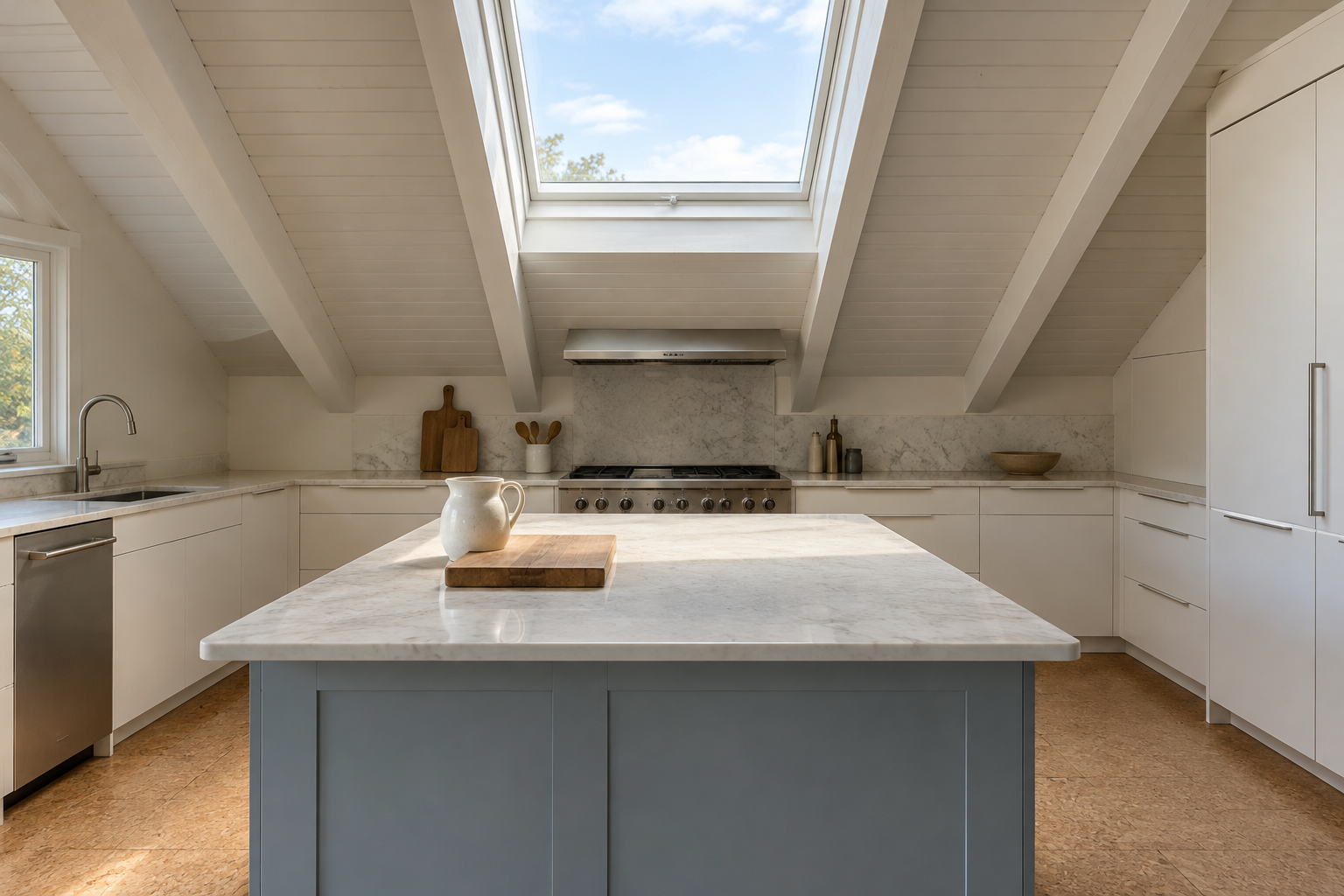
A kitchen on the top floor, or one with roof above it, can take its daylight from overhead. A window in the roof over the island or the counter lights the work surface evenly, from above, so nobody stands in their own shadow during the day. Light from overhead also changes through the day, cool in the morning and warmer as the afternoon goes on.
This is building work, done in the roof, often with a permit, and a south-facing roof window can make a kitchen hot in summer unless it has a blind. Where an attic separates the kitchen from the roof, a light tube carries daylight down through it to a small round diffuser in the ceiling, with far less work.