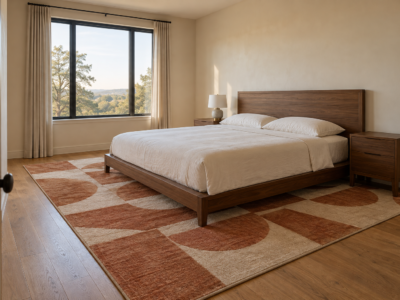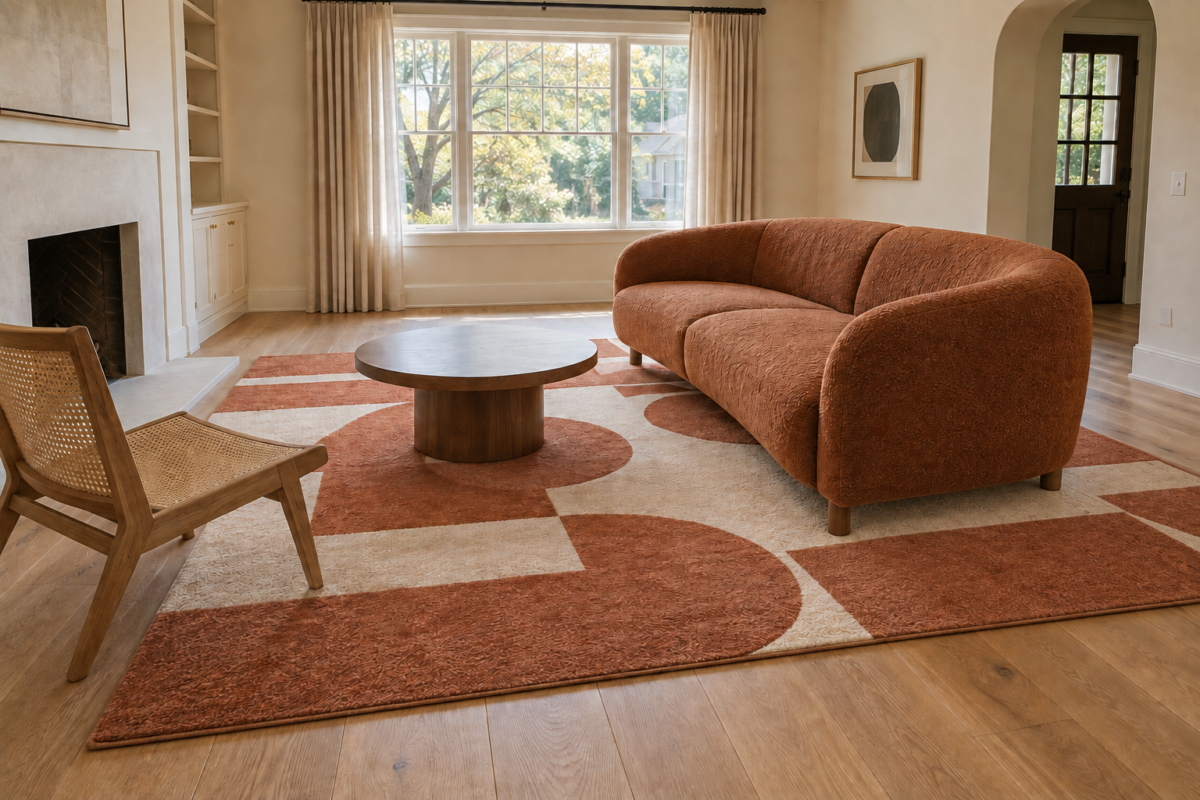
A bedroom rug only has to work with a bed and two nightstands. A living room rug has to work with a sofa, usually a chair or two, and a coffee table, and each of those pieces has its own answer to where the rug’s edge should fall. That is the real reason living room rug placement advice online feels so inconsistent. Most of it tries to give one rule for furniture that does not follow one rule.
Once a rug size is settled, the placement decision comes down to three real options for the seating, one near-constant rule for the coffee table, and one habit that ties all of it together.
The Coffee Table Isn’t Part of This Decision
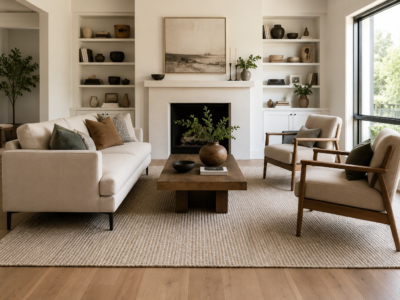
Start here, because it simplifies everything that follows. Whatever a sofa and chairs end up doing, the coffee table almost always sits fully on the rug. It anchors the seating group visually, and a coffee table with only two legs on the rug reads as misplaced in a way that a sofa’s back legs floating past the edge does not.
This holds regardless of the rug’s overall size relative to the room. Even a rug too small to reach a sofa’s back legs is usually still large enough to hold a full-size coffee table underneath it. If it is not, the rug is probably undersized for the room, which is a sizing question, not a placement one. Sizing a coffee table to the sofa in front of it makes this easier to judge, since a table sized correctly for the seating tends to sit comfortably within a correctly sized rug too.
Front Legs On, Back Legs Off
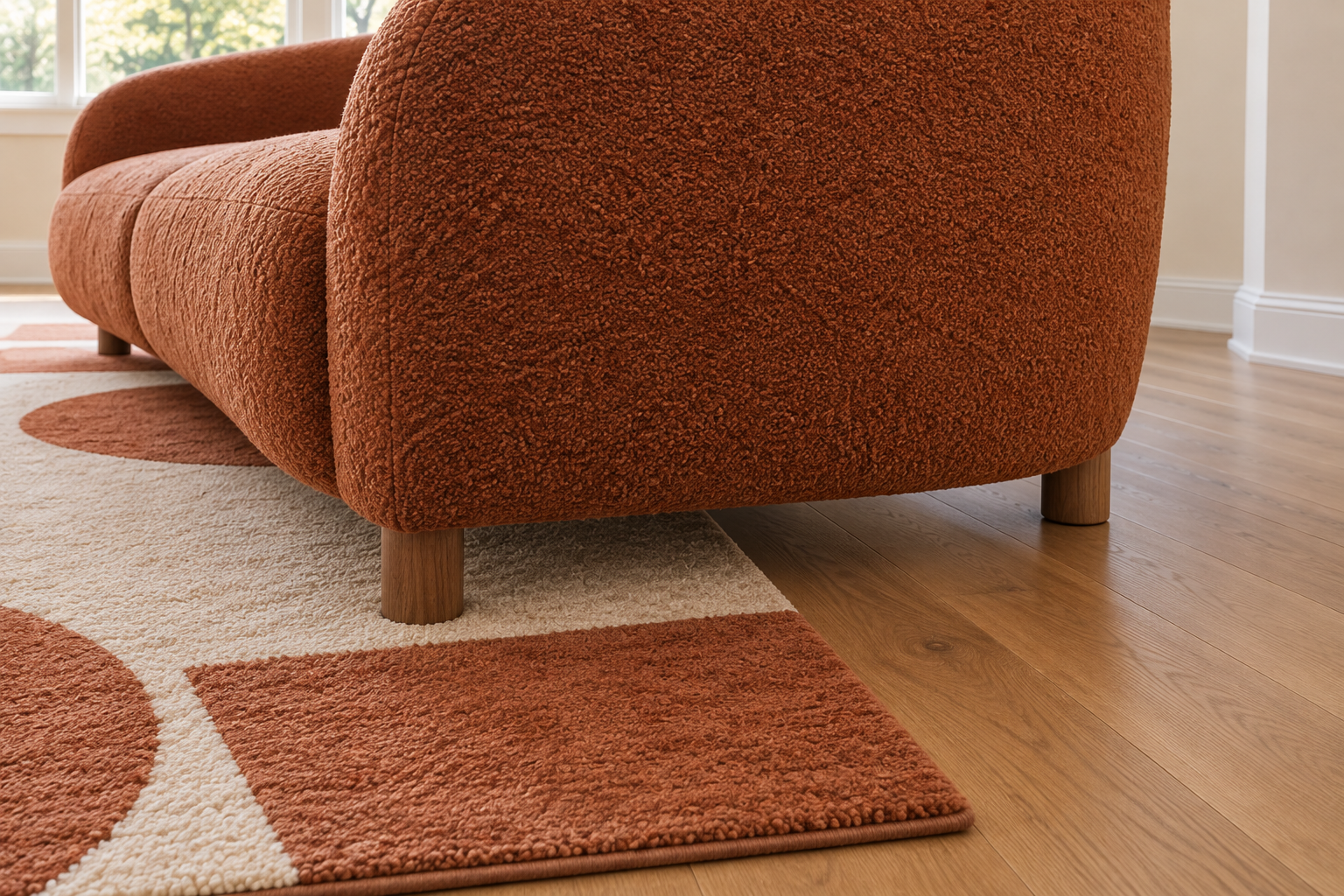
This is the default that works across the widest range of living rooms. The sofa’s front legs rest on the rug while the back legs stay on bare floor, and any chairs in the grouping follow the same pattern. A useful starting point is letting roughly 12 to 18 inches of rug show in front of the seating, enough to register as intentional without needing a rug large enough to swallow the whole arrangement.
The visual logic is simple: the rug still ties the group together at the point where people’s feet actually land, without demanding a rug so large it also has to run under every back leg in the room. This is a common guideline, not a fixed measurement. A room with a smaller sofa and a smaller rug can look right with a narrower margin, as long as the rug does not read as barely catching the front legs by accident.
All Four Legs On the Rug
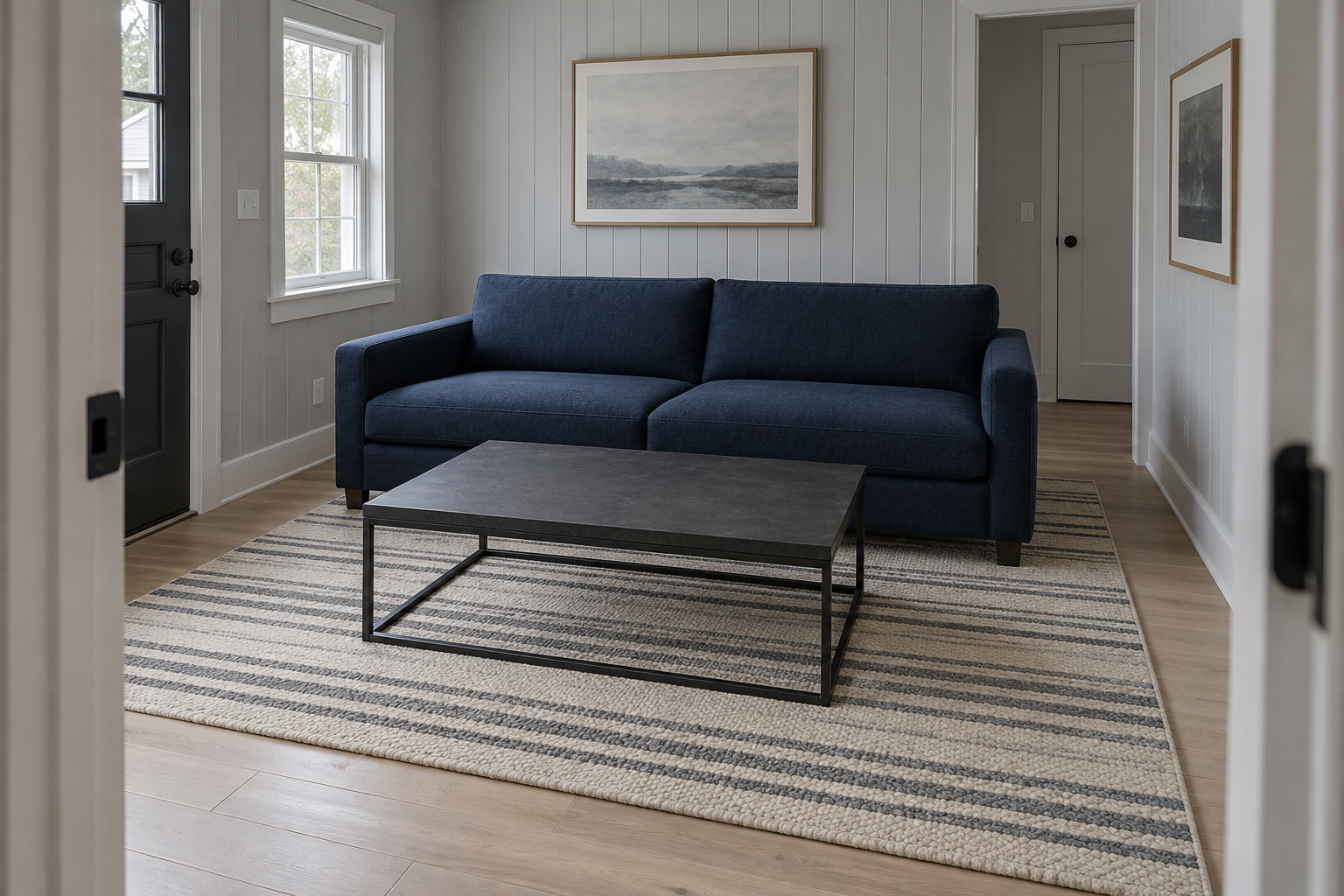
This needs more room and a bigger rug than the front-legs approach, generally something in the 9×12 range for a standard living room, sized so the rug’s edges still show a real margin, generally 12 to 18 inches, beyond the seating on every side. When the room has that much floor to spare, it is often the most finished-looking option, since every piece in the grouping reads as anchored to the same surface.
A sofa that is already a stretch for the room makes this option harder to pull off, since the rug then has to be large enough to clear a sofa that barely fits in the first place. In a smaller or more modestly sized living room, front-legs-on usually gets the same visual result with a rug that is easier to fit.
Skipping the Furniture Entirely
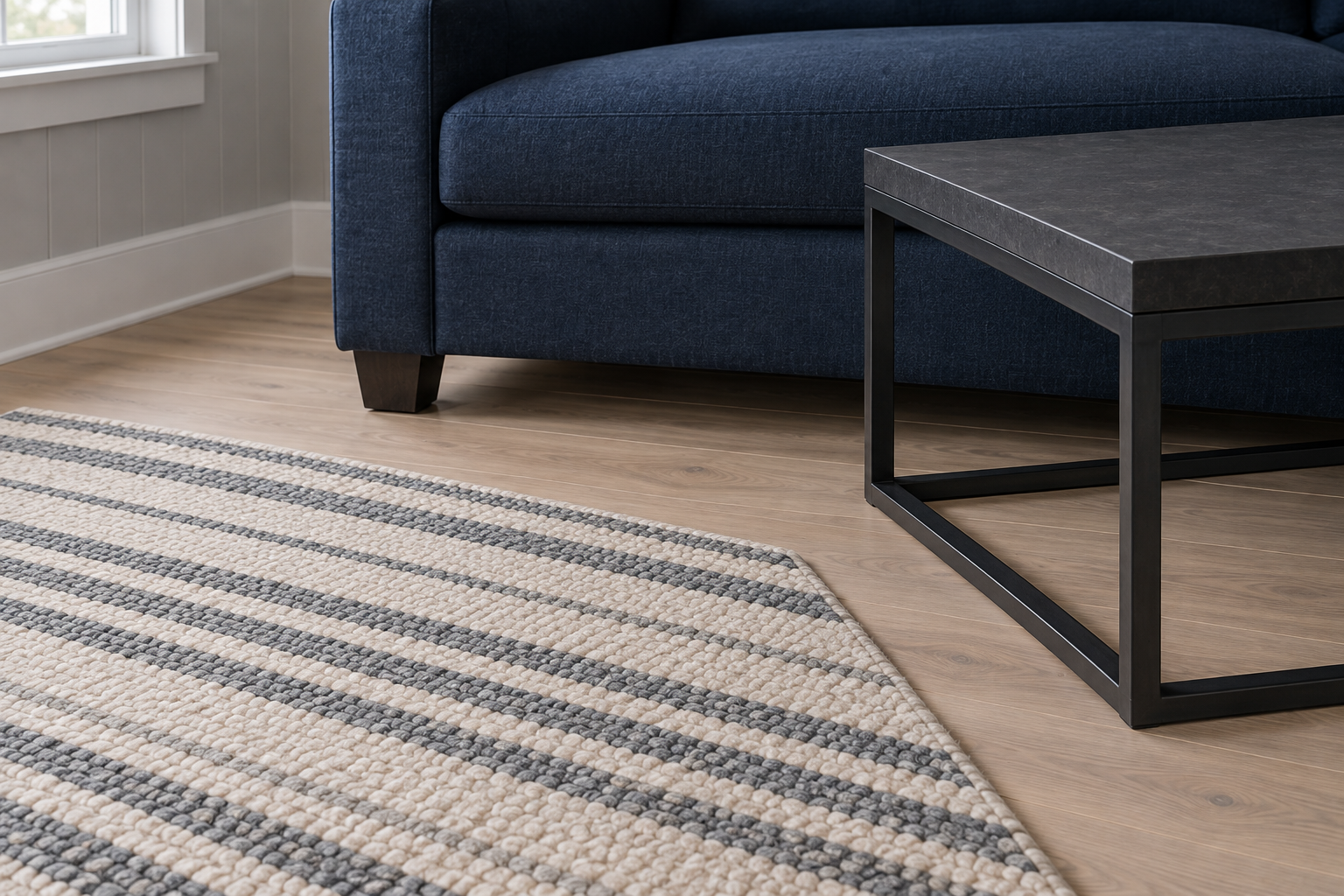
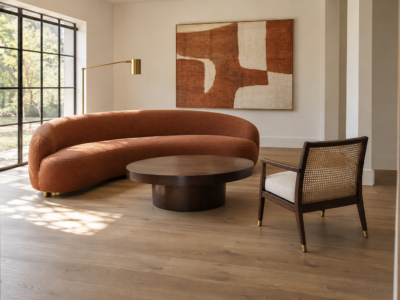
Sometimes the honest answer is that neither of the above fits. A rug already on hand that is too small to reach any seating, or a room too tight to spare the floor space either approach needs, can still work centered in whatever open area remains, not touching the sofa or the coffee table at all.
The tradeoff is real. The rug stops tying the seating group together and becomes its own separate element in the room instead. In exchange, a visible strip of floor around the rug’s edges tends to make a tight room read as more open, since the eye registers the floor continuing past the rug rather than stopping at a wall-to-wall edge that never quite reaches the furniture anyway.
Whichever of these three fits the room, one habit makes any of them look planned instead of accidental. Every piece in the seating group needs to agree. If the sofa’s front legs are on the rug, the chairs’ front legs should be too, not one chair fully on while another sits entirely off. A rug that treats one piece in the grouping differently from the others is the actual mistake, more often than picking the “wrong” option in the first place.