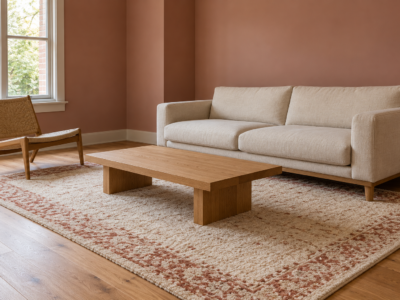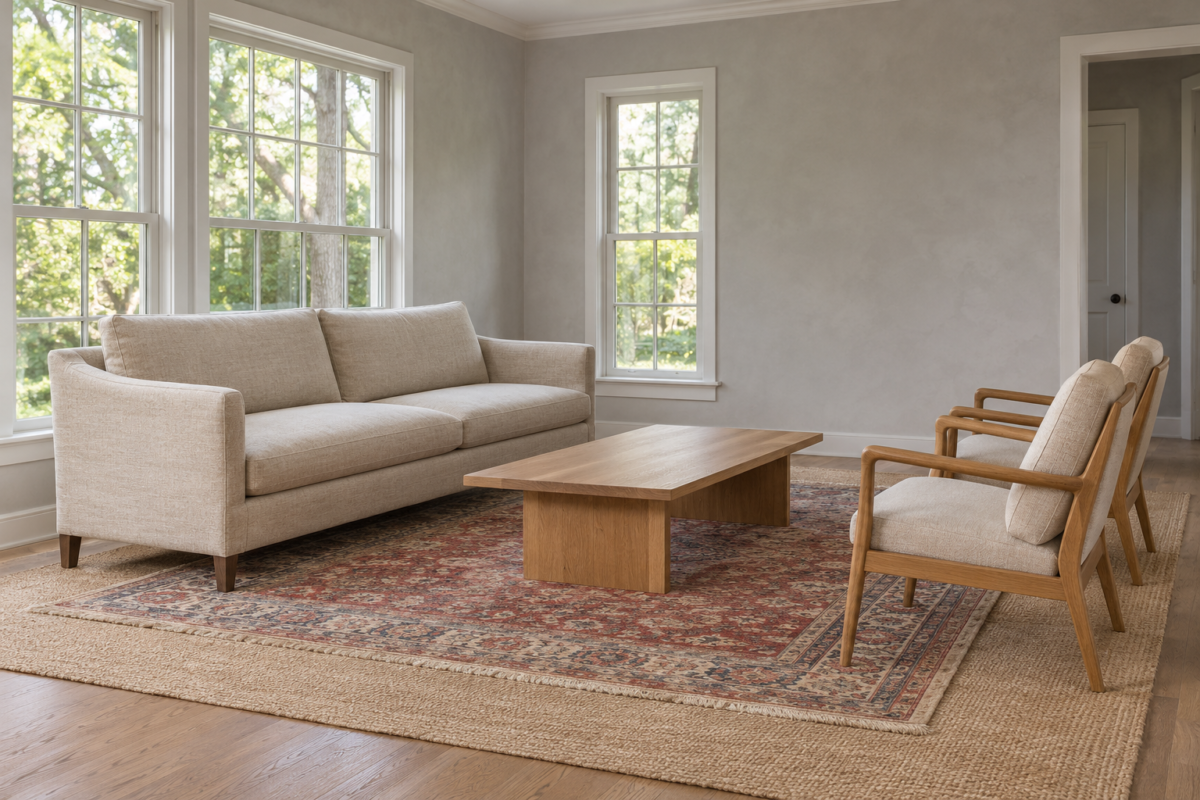
A rug that’s too small for the room, a vintage piece or a favorite flatweave, can still go down in the seating area if a larger, plainer rug goes under it first. The lower rug shows as a border around the upper one, and the floor gets two textures or two patterns instead of one.
Of the two, the lower rug decides most of the practical questions. It sets the size the seating needs, takes the legs of the sofa and chairs, and has to lie flat enough that the rug on top doesn’t rock or ripple over it. The upper rug is the one the eye goes to.
A Flat, Larger Rug Underneath
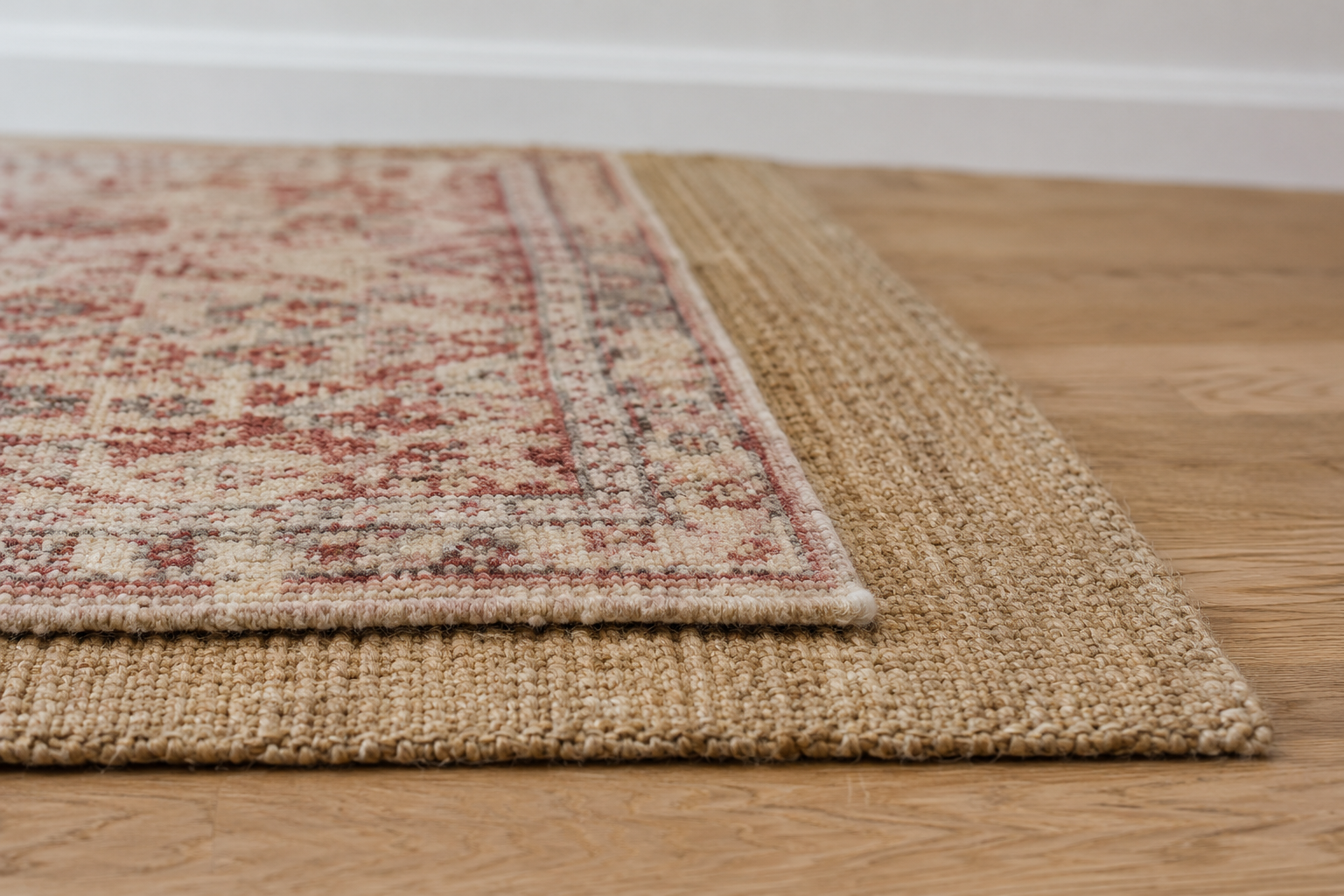
The base is usually a flatweave or a rug with a very short pile, in a plain natural fiber such as jute, sisal, cotton, or wool. A thin, firm base gives the top rug a level surface. A thick or shaggy one lets the top rug sink and shift, and its edges stand up where the pile below is uneven.
Size the base as if it were the only rug, large enough for at least the front legs of the sofa and chairs, using the same rug sizes as for a single rug. Layering often starts with a rug that is a little small for the room, and the base is what fixes that.
How Much of the Lower Rug Shows
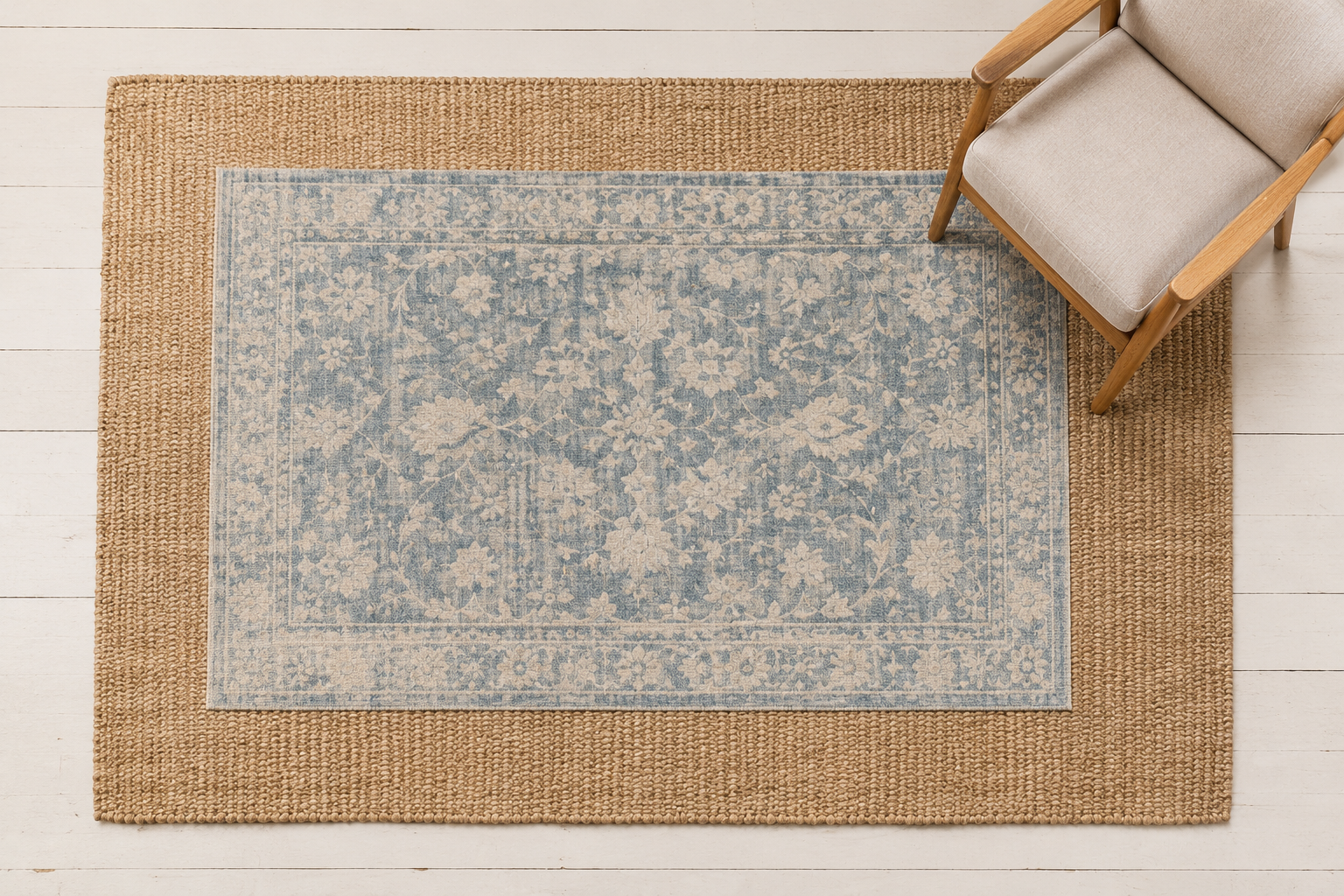
The lower rug should show as a clear band around the upper one, wide enough to be seen as a frame. In a living room, a band of about 12 to 18 inches on each side is a good place to start. Much narrower, and the base shows as a thin line that is easy to mistake for a rug slightly too big. Much wider, and the top rug looks like a mat floating in the middle.
The band comes from subtracting the top rug’s size from the base’s and halving the difference for each side.
| Base rug | Top rug | Band on the long sides | Band on the short sides |
|---|---|---|---|
| 9 x 12 ft | 6 x 9 ft | 18 in | 18 in |
| 8 x 10 ft | 5 x 8 ft | 18 in | 12 in |
| 10 x 14 ft | 8 x 10 ft | 12 in | 24 in |
| 6 x 9 ft | 4 x 6 ft | 12 in | 18 in |
For a 9 x 12 base with a 6 x 9 top rug, the widths differ by 3 feet, 36 inches, which leaves 18 inches on each side, and the lengths also differ by 3 feet. The bands don’t have to be equal. A top rug pushed toward the sofa, leaving more of the base showing at the far end, can suit a room where the seating faces one way.
Plain Below, Pattern Above
The usual pairing is a plain textured base under a patterned top rug: a woven jute under a vintage wool rug, a sisal under a faded kilim. The base shows texture, and the top carries the color and pattern, so the two have different jobs and don’t compete.
Color ties them together. A top rug that has the base’s color somewhere in its pattern, a sand or a cream among its reds and blues, looks related to the rug under it. Two patterned rugs can work, but they need patterns at clearly different scales, a small grid under a large medallion, the same way patterns are mixed anywhere else in a room.
A Smaller Rug Set at an Angle
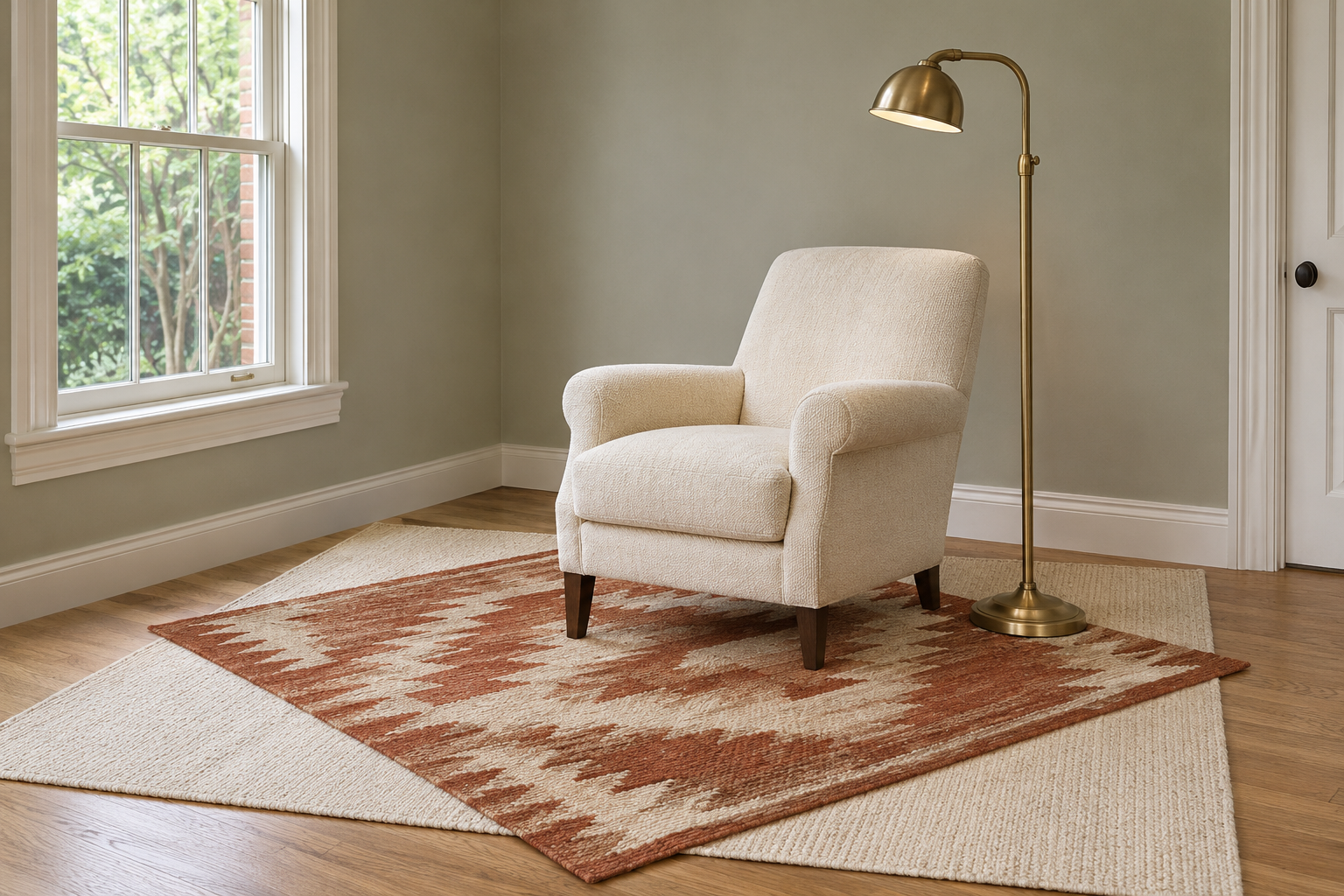
A top rug doesn’t have to be square to the base. Turned at an angle, with its corners crossing the edges of the rug below, it breaks up a room of straight lines and suits a small rug under a single reading chair, where an even band would leave very little of it showing.
Keep an angled rug to one corner or one chair. Several rugs at different angles in one room look scattered rather than layered.
Layering in a Bedroom
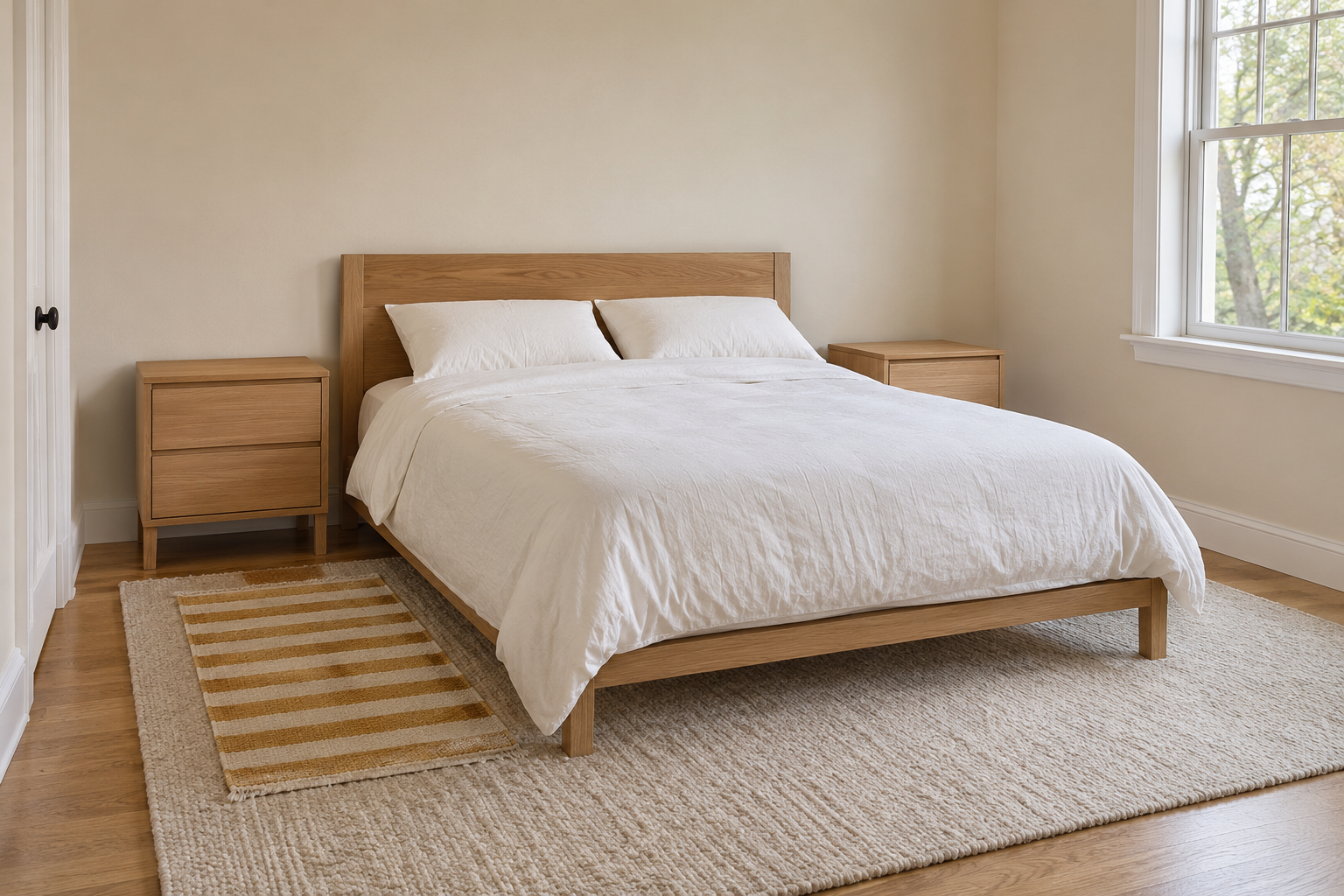
In a bedroom, the base rug goes under the lower two-thirds of the bed and extends past both sides, the usual placement for a single rug. The layer on top is small, a runner or a narrow rug along one side of the bed, or one at each side, where feet land first thing in the morning.
The small rug can be softer than anything else in the room, a deeper pile or a sheepskin, since it sits away from chair legs and heavy traffic and only bare feet cross it.
Over Wall-to-Wall Carpet
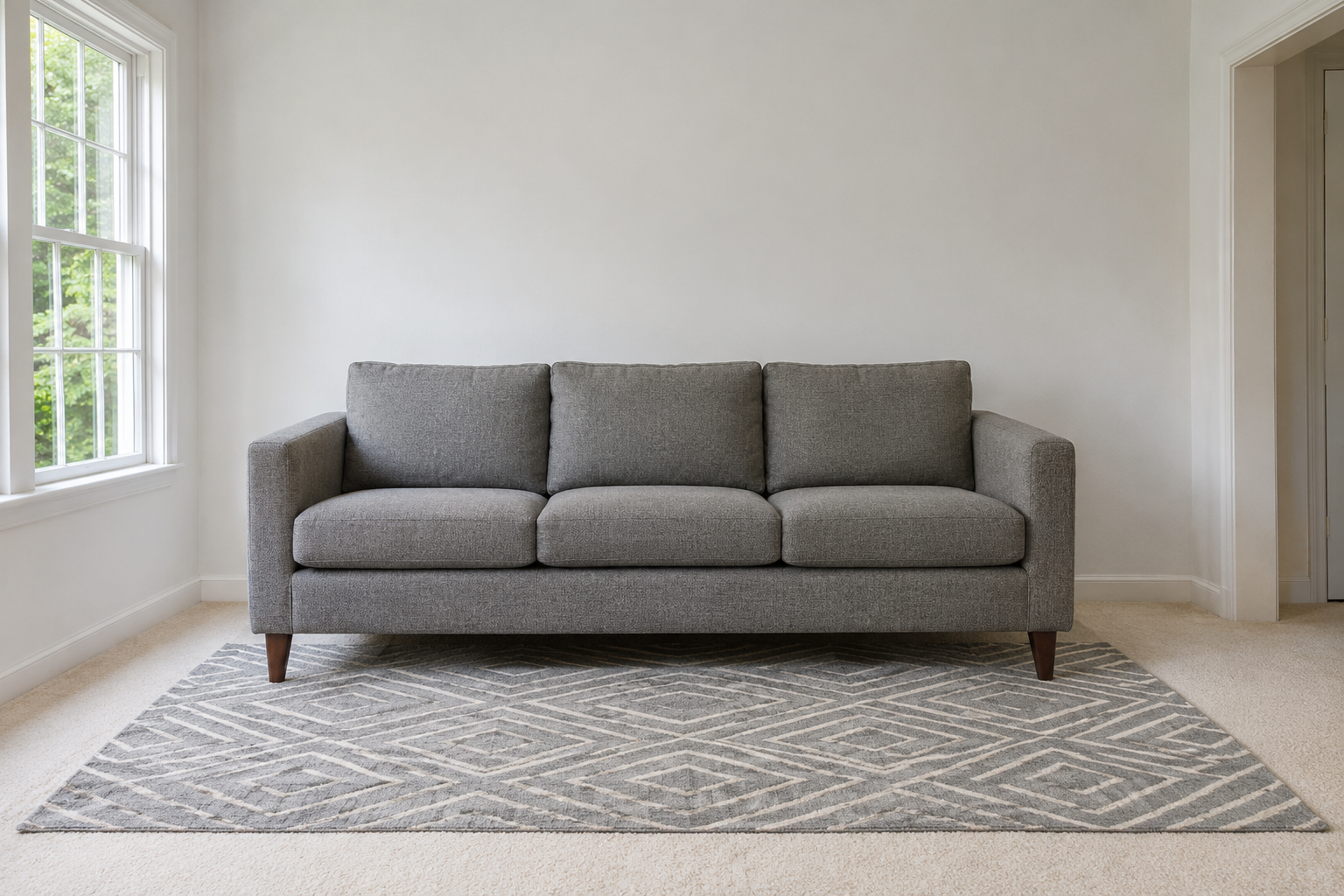
On wall-to-wall carpet, the carpet itself is the lower layer. A rug laid on top gives a room with plain carpet color and pattern, and defines the seating area in a room where the floor is the same from wall to wall.
A rug on carpet tends to creep, pushed along by footsteps until it wrinkles against the furniture. A rug pad made for use on carpet holds it in place, since pads made for hard floors grip the floor, not carpet pile. A flatweave or a short pile sits flatter on carpet than a thick rug, and a carpet with a short pile makes a steadier base than a deep one.
Keeping Two Rugs Flat
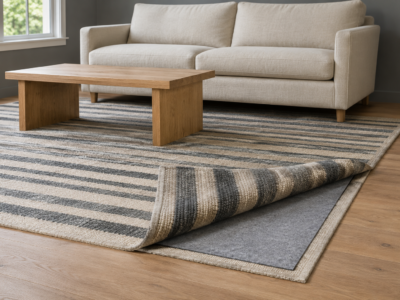
A top rug can slide on the one below it, especially a flatweave on smooth jute. A thin rug pad cut a little smaller than the top rug, or rug tape made for the purpose, holds it without adding height.
The edge of the top rug is a small step up, and it catches toes where it crosses a path. Keep its edges out of the main route through the room where possible, check that any door nearby still swings over both rugs, and flatten a curled corner as soon as it starts.