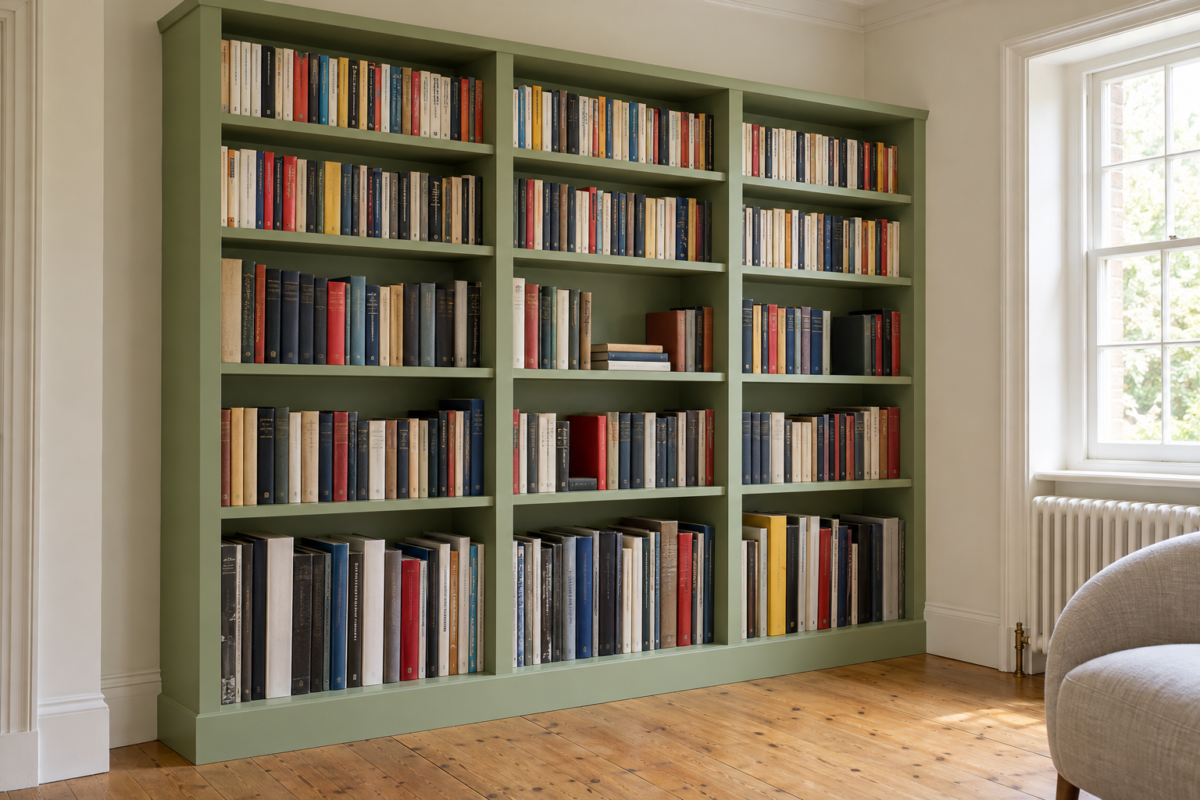
A shelf 10 inches deep, with 11 inches of clear height above it, holds nearly every novel and most hardcover nonfiction. If that describes the collection, those two numbers are the answer, and they’re close to what many bookcases are sold with.
They stop working at the edges of a collection. A shelf of small paperbacks set at 11 inches wastes about a third of its height. An art book 13 inches tall won’t stand up at all. So before choosing a bookcase, or moving the pins in one, measure the largest book of each kind on the pile.
Start From the Books
Books fall into four rough sizes, and each one asks for a different shelf.
| Kind of book | Typical width, spine to fore edge | Typical height | Shelf depth | Clear opening |
|---|---|---|---|---|
| Small paperback | 4.25 inches | 7 inches | 6 to 8 inches | 8 inches |
| Larger paperback and standard hardcover | 5.5 to 6.5 inches | 8 to 9.5 inches | 8 to 10 inches | 10 to 11 inches |
| Large illustrated book | 9 to 12 inches | 11 to 14 inches | 12 to 13 inches | 13 to 15 inches |
| Vinyl LP in its sleeve | 12.4 inches | 12.4 inches | 13 inches | 13.5 to 14 inches |
Book sizes are typical American editions. Publishers vary, so the tape measure has the last word.
Depth Is the Widest Book Plus an Inch
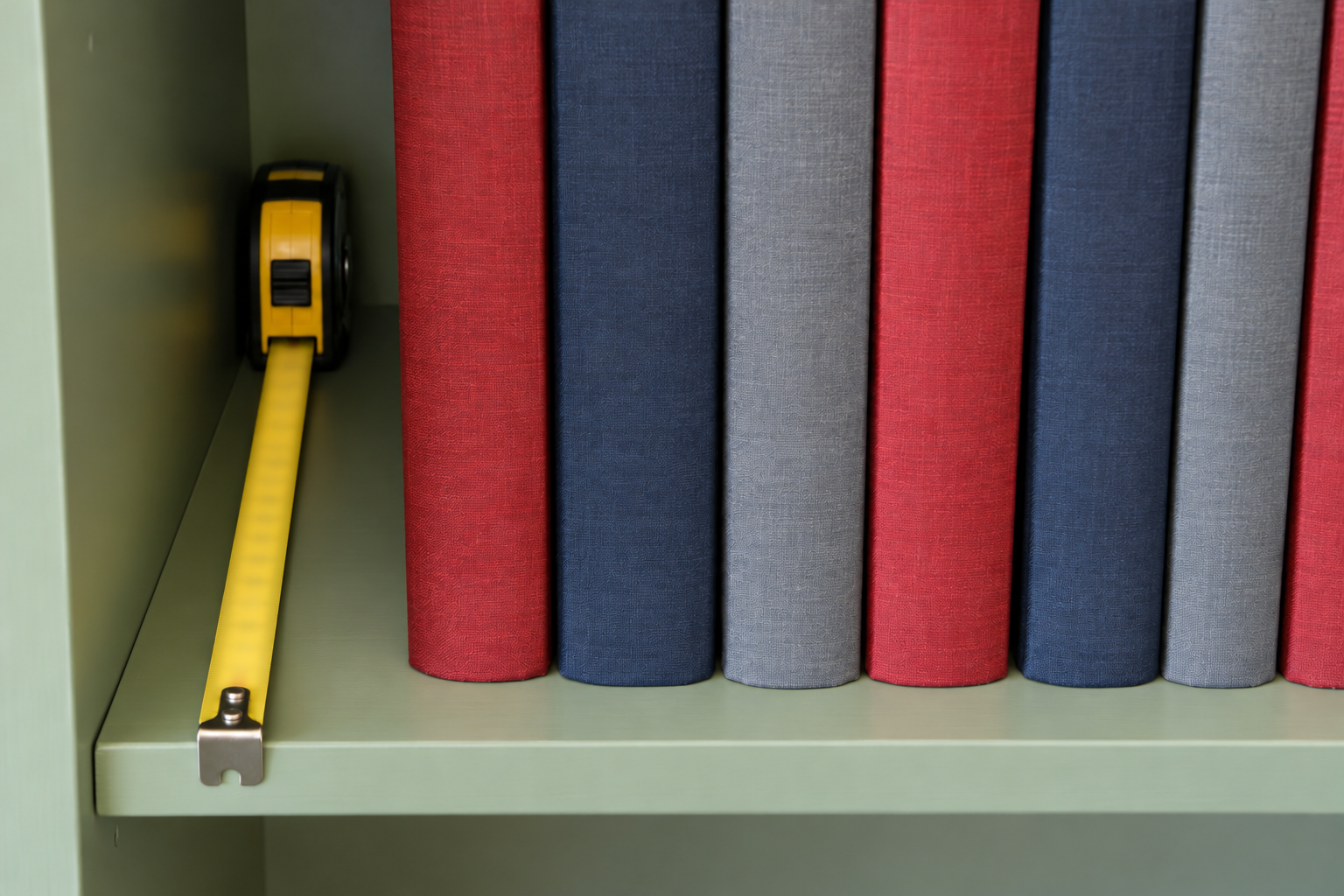
Shelf depth here means the usable surface, from the front edge to the back panel. Take the widest book that will stand on the shelf, measured from spine to fore edge, and add about an inch. The inch lets the spines sit a little back from the edge and keeps the pages off the back panel.
By that rule, 8 inches is enough for a wall of paperbacks and novels, 10 inches takes almost every hardcover, and 12 inches takes large format books. Records need 13.
Extra depth isn’t free. A shelf 12 inches deep holding books 6 inches wide leaves a ledge in front that collects keys and mail, or the books get pushed to the back where their spines sit in shadow. It also costs floor. Across an 8 foot wall, 4 extra inches of depth uses more than 2.5 square feet of the room. If a deep case is already in the house, a second row on a riser makes use of it.
Spacing Is the Tallest Book Plus an Inch

Spacing is where two different measurements get confused. The clear opening is the height a book has to fit into, from the top of one shelf to the underside of the next. The spacing of the shelves, center to center, is that opening plus the thickness of a shelf, usually 3/4 inch. Instructions and product pages quote either one, so check which.
For the opening, take the tallest book in the row and add about an inch. A book comes off a shelf by being tipped forward at the top, and its top corner swings up slightly as it tips, so it needs that clearance. The inch is also room for a finger.
An opening much taller than its books is wasted height, and it adds up. Four shelves of paperbacks fit in the height that three take at hardcover spacing. On a case with adjustable shelves, the pin holes are typically a little over an inch apart, so the opening can only be set to the nearest hole. Round up.
Laying Out a Whole Case
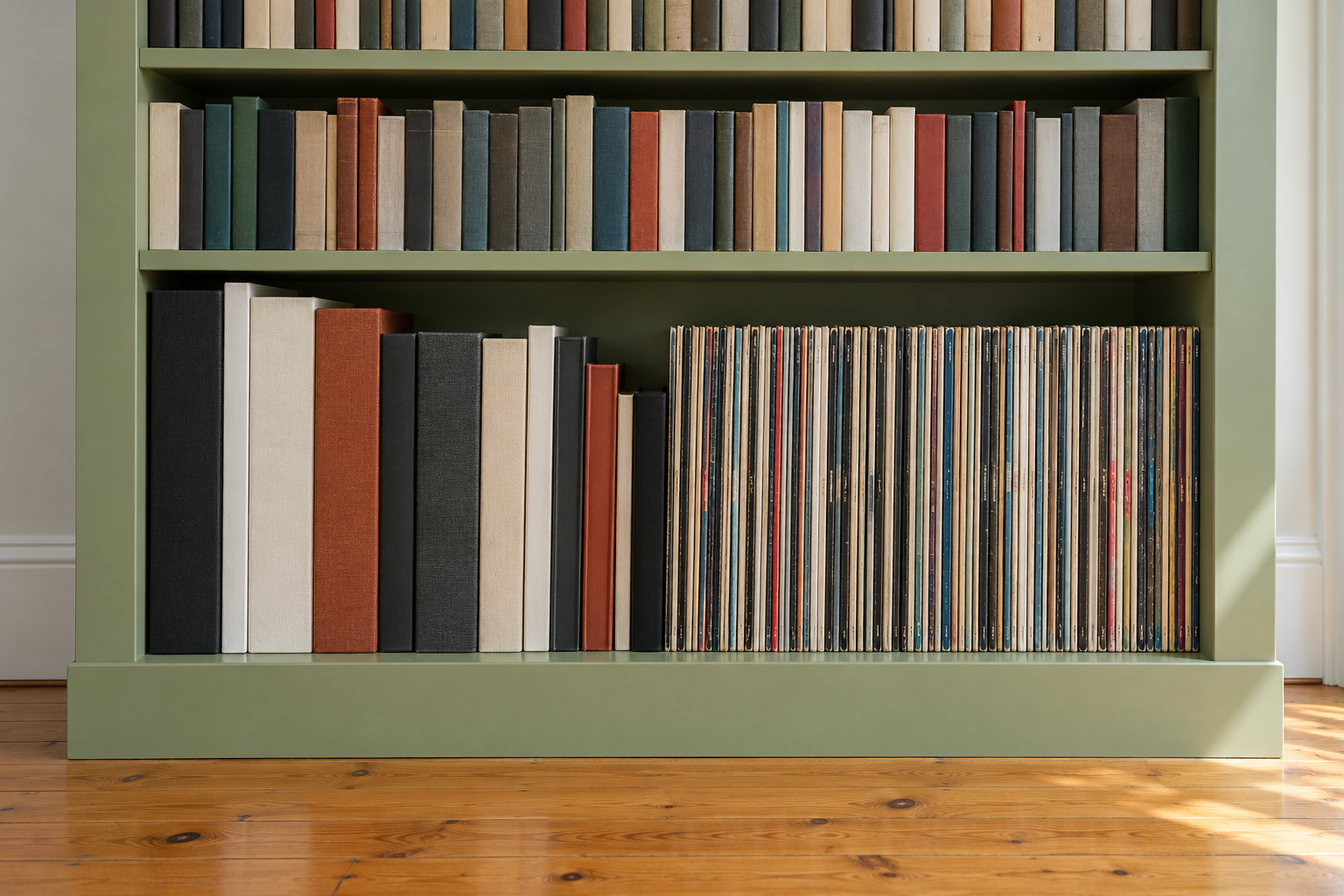
Here is an example for a case with 72 inches of clear height inside, between its top and bottom panels, and shelves 3/4 inch thick.
Put the tall opening at the bottom. Large books are heavy, and weight low down keeps a case stable. Give it 14 inches, which takes art books and records. Above that, four openings of 11 inches for hardcovers. Those five openings add up to 58 inches. Six openings need five shelves between them, which take 3.75 inches. That leaves 10.25 inches for the top opening, enough for paperbacks or shorter hardcovers.
The check is that everything sums to the inside height: 14, plus 44, plus 10.25, plus 3.75 for the shelves, equals 72. Working downward from a different mix of books changes the numbers and leaves the method alone.
How Long a Shelf Can Be

Books are heavy. A full shelf carries roughly 20 to 25 pounds for every foot of its length, and over months a shelf that’s too long for its material bows in the middle and stays bowed.
As rules of thumb for a shelf 3/4 inch thick and loaded with books, particleboard and MDF hold straight over about 24 inches between supports, plywood over about 30, and solid wood over about 36. These are woodworking guidelines, and a bought bookcase has its own rated load per shelf, which is the figure to follow for that case.
A wider bay doesn’t need thicker shelves. An upright divider at the middle halves the span, and a strip of solid wood glued along the front edge stiffens it. Bays about 30 inches wide are common on freestanding bookcases.
Fix a Tall Case to the Wall
A bookcase 6 feet tall with six shelves 30 inches long holds something like 300 to 375 pounds of books, on a base 10 or 12 inches deep. That is a tall, narrow, heavy object, and it can come forward if a child climbs the lower shelves or a carpet edge tilts it.
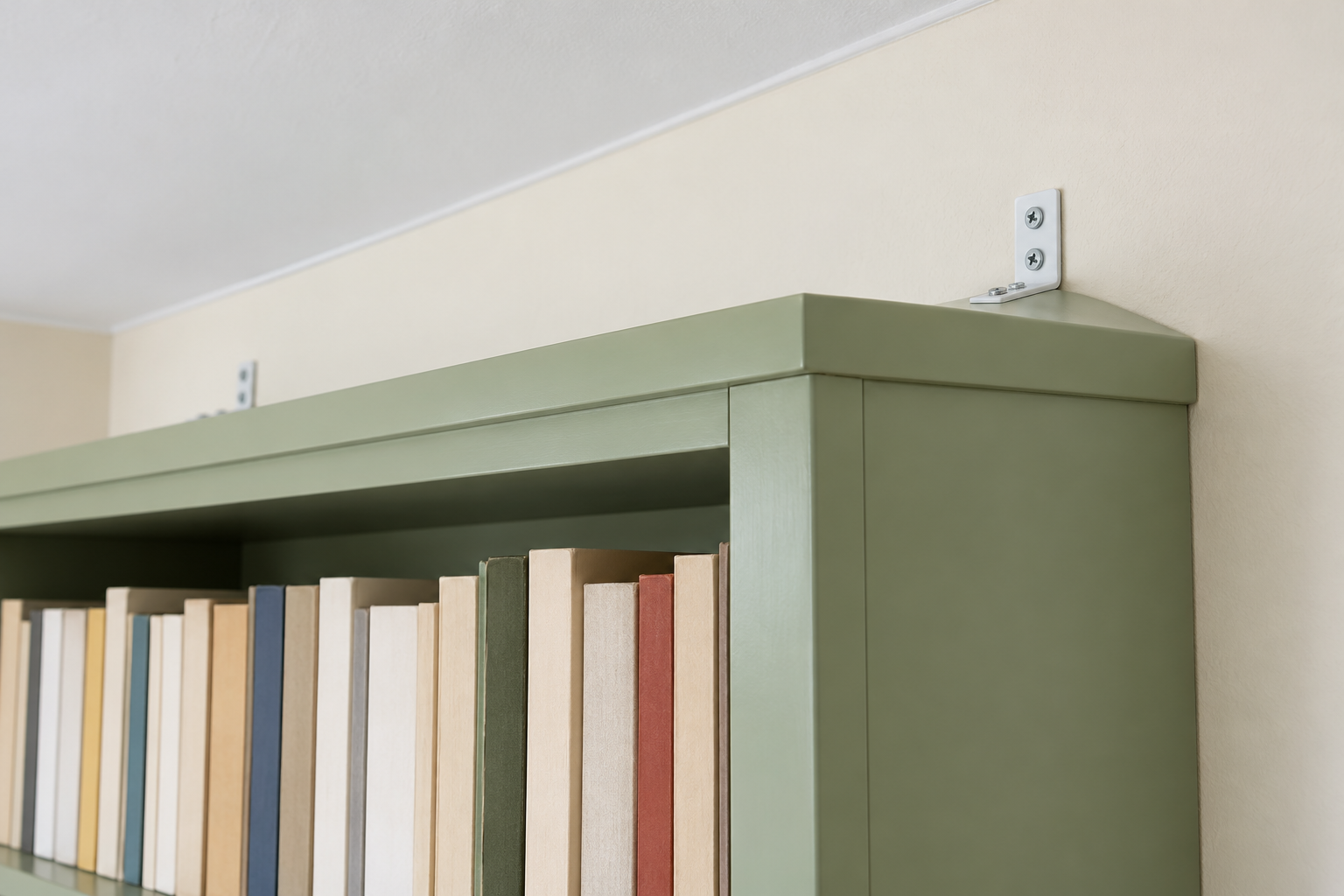
Fix the top of any tall case to the wall. Many new ones come with a strap or a bracket for this, and the screw needs to go into a stud or a proper wall anchor, since a screw in bare drywall pulls out. Then load the case from the bottom up, with the heaviest books lowest.