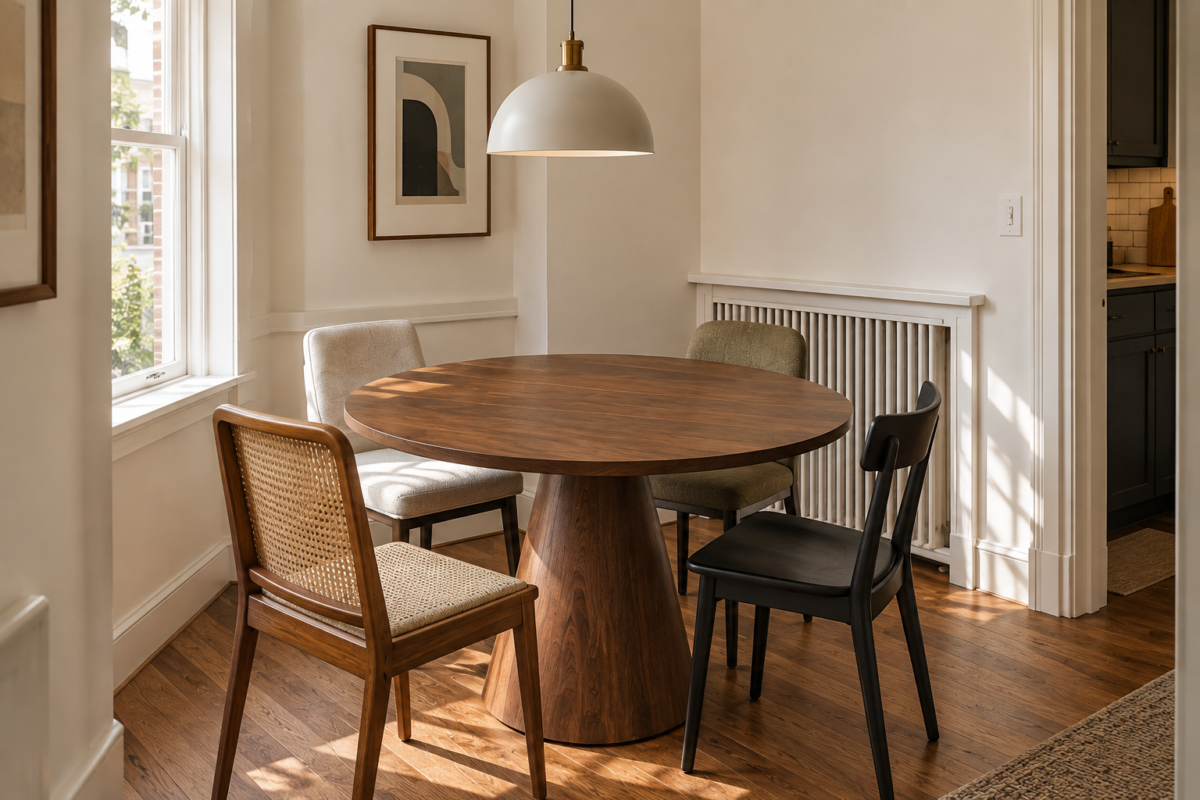
Most dining table advice starts with style: round tables feel casual, rectangular tables feel formal. In a room with real architectural constraints, an off-square corner, a narrow width, an irregular bay window, style is the least important part of the decision. Shape is a fit problem first, and style only after fit is settled.
Here’s how three genuinely awkward room types respond to table shape, not as a preference exercise but as a real space-planning problem.
Round Tables Solve Corners, Not Just Style
A rectangular table forces four sharp corners into a room. If that room has its own off-square corner, a radiator, an angled wall, a built-in eating into the space, those corners collide. A round table has no corners to collide with anything. It rotates freely within an awkward space in a way a rectangular table’s fixed footprint can’t.
This is a practical reason to choose round, not just a style preference. A round table with the same seating capacity as a small rectangular one often fits an irregular corner more comfortably, since there’s no orientation that puts a table edge directly into an obstruction.
Rectangular Still Wins in a Narrow Room
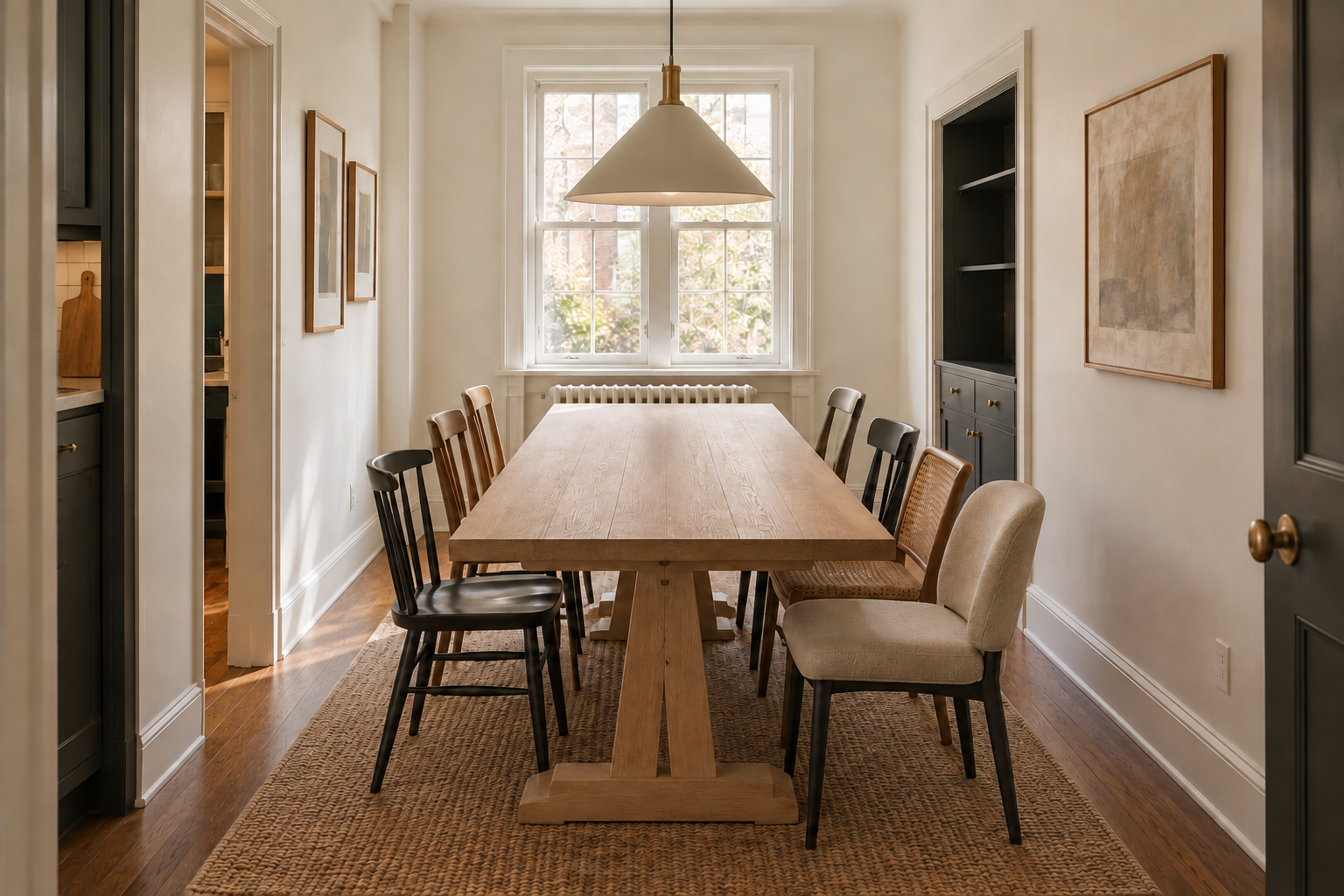
In a narrow room, a round table loses its advantage. A round table’s diameter has to accommodate the same clearance on every side, which wastes width in a room that’s already tight on one dimension. A rectangular table uses a narrow room’s length efficiently while keeping the width to whatever the room can actually spare.
The real constraint in a narrow dining room usually isn’t the table itself. It’s the clearance on the tight side, where chairs sit closer to the wall than the ideal. Confirm at least 24 inches between chair and wall on that side before locking in a table width. Less than that turns getting in and out of the chair into the daily friction point.
Oval as the Compromise Shape
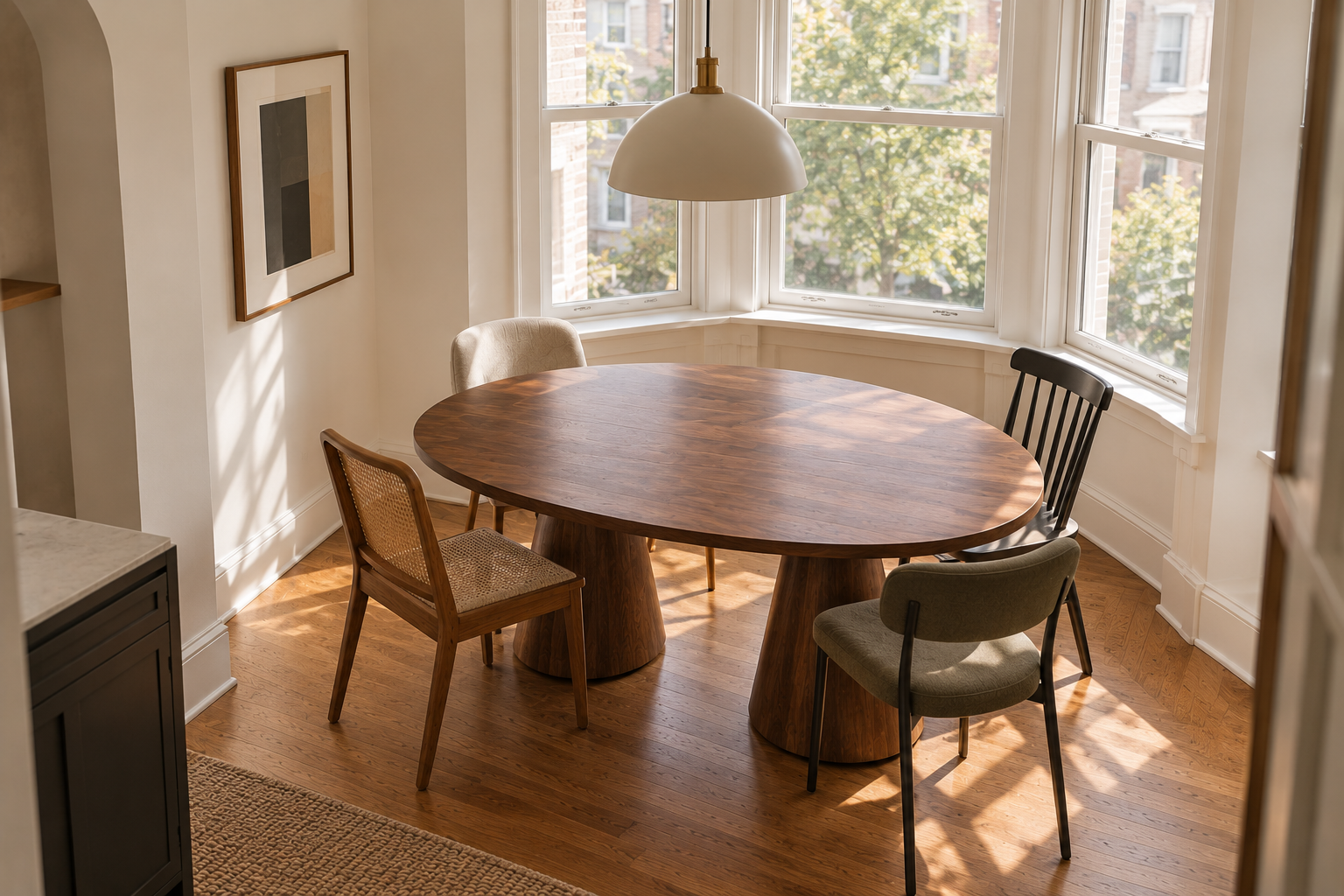
An oval table works when a room has one specific irregular feature: a bay window, an angled wall. A straight-edged rectangular table can’t follow it. A full circle doesn’t fully solve it either. The oval’s curved ends echo a round table’s flexibility at the corners while keeping a rectangular table’s length efficiency along the sides.
It’s a genuine compromise shape, not a lesser choice between the other two. In a bay-window alcove specifically, an oval often follows the window’s curve better than either alternative, letting a chair sit closer to the glass without a flat table edge cutting across it.
Frequently Asked Questions
How many chairs fit around a round table versus rectangular?
A 48-inch round table typically seats four to six, similar to a 60 by 36 inch rectangular table. The exact count depends on chair width more than table shape (see how many chairs fit).
Is a square table ever the right choice?
Only in a genuinely square room or a very small breakfast nook, since a square table wastes proportionally more floor space than a round one of similar seating capacity in most other room shapes.
Should the rug shape match the table shape?
Not necessarily. A rectangular rug under a round table is a common, workable pairing as long as the rug extends far enough past the chairs on every side (see rug size guide).