A curtain meant to reach the floor that stops a few inches above it usually got there by accident: a panel bought in the nearest stock size, a rod mounted higher than the panel could reach, a length chosen before anything was measured. The gap is small, and it is easy to avoid once the measurement starts in the right place.
There are three floor lengths worth knowing, and each one suits a different amount of daily traffic.
Float: The Safest Default for Most Rooms
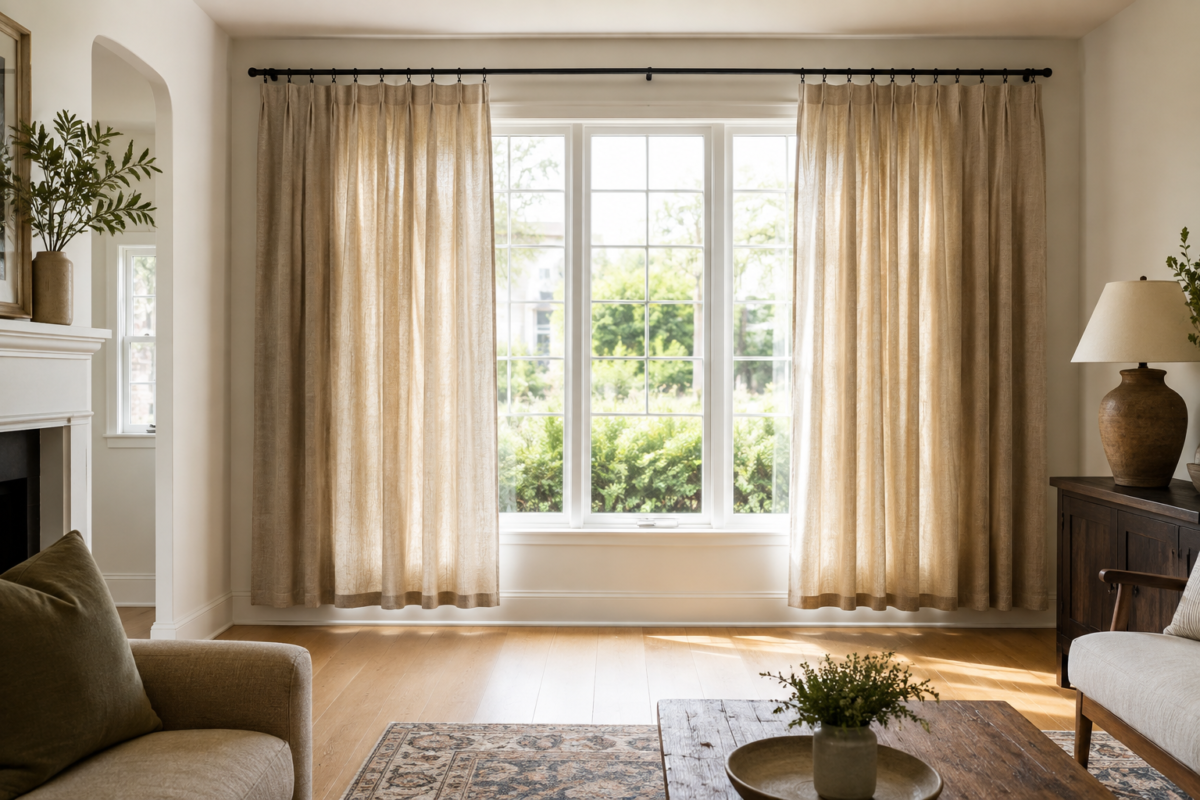
A float length, where the hem hangs about half an inch above the floor, is the most practical choice for a room that gets daily use. It keeps the fabric off the floor, away from foot traffic and vacuum cleaners, and from across the room the half inch is hard to see, so the panel still looks full length. This is a sound default for living rooms with kids or pets and for most bedrooms. When in doubt, float is the length least likely to cause trouble.
Break: A Slightly Softer Alternative to a Hard Float
A break length lets the curtain hang slightly longer, by about an inch, enough that the fabric touches the floor and makes a soft fold, similar to how a trouser leg breaks over a shoe. It is a softer line than a float without the upkeep of a puddle, and the fold takes up small differences in a floor that is not quite level. A break shows best in fabric with some weight, such as lined linen or velvet, which holds the fold. A thin unlined sheer tends to crumple instead. Because the hem rests on the floor it picks up some dust, so this length suits a living room or dining room where the panels mostly stay in place.
Puddle: Reserved for Rooms That Won’t Take Daily Traffic
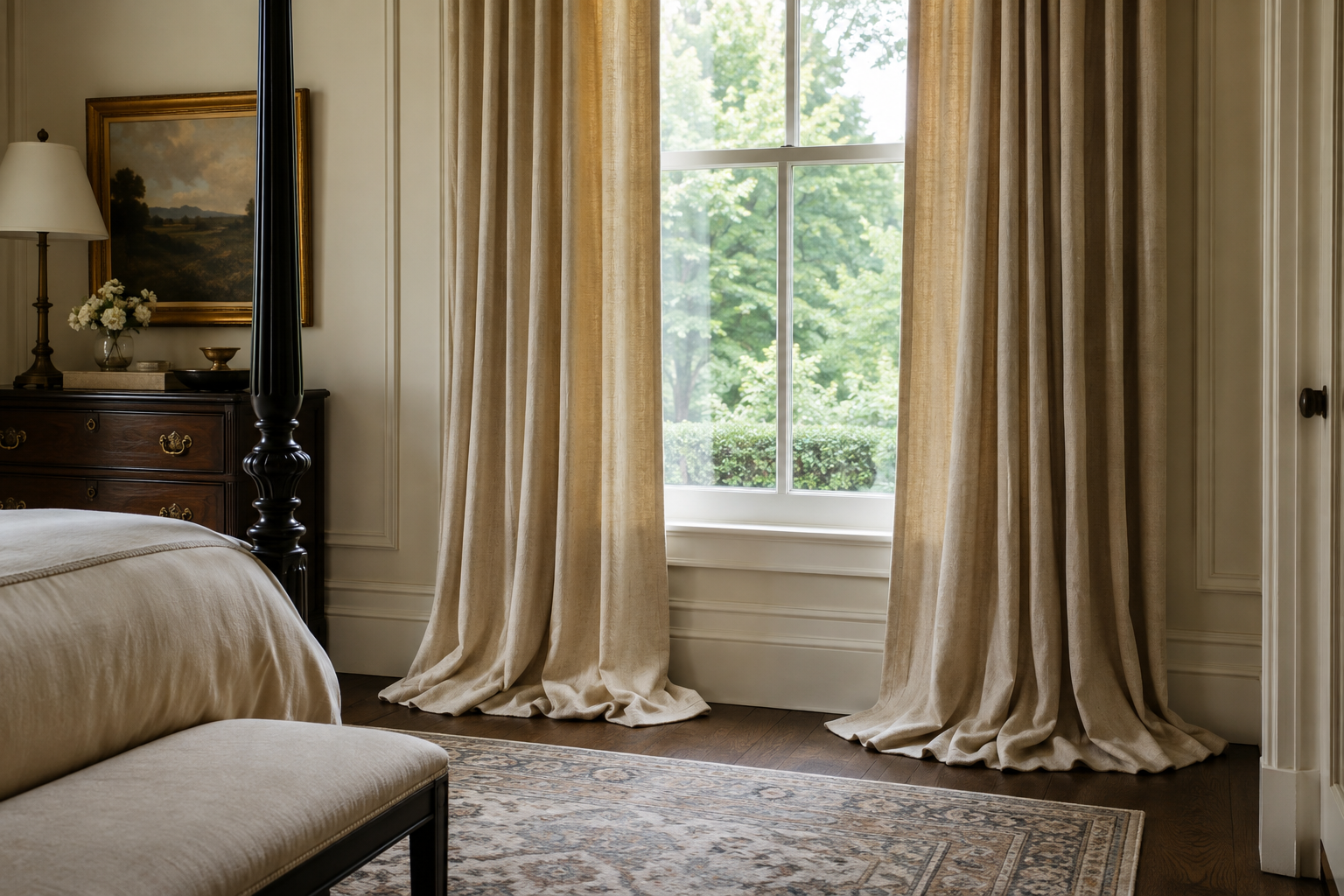
A puddle length adds more fabric, from two to four inches for a modest pool up to six or eight for a heavy one, and the extra spreads across the floor. It is traditionally the most formal of the three. It also collects dust, gets walked on anywhere near a doorway or a busy path, and has to be arranged again each time the curtain is drawn. That is why it belongs in rooms without constant use, such as a formal living room, a primary bedroom, or a dining room kept for occasions. A puddle length in a mudroom or a kids’ playroom is mostly upkeep.
Measure From Where the Panel Hangs
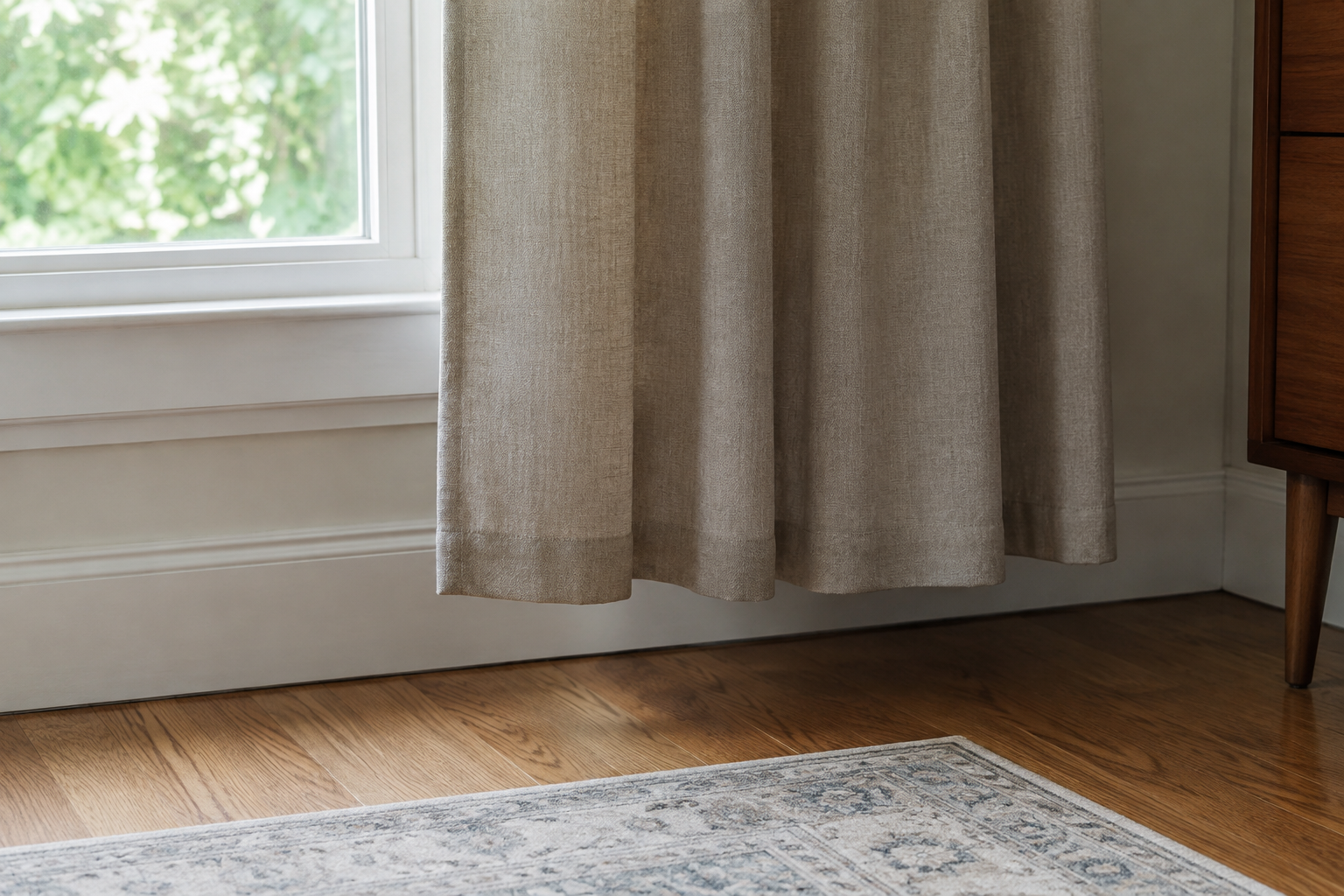
A finished length is the distance from the point where the fabric starts to the hem. The hardware sets that starting point, and it is rarely the top of the window frame.
Decide the rod height first. Four to six inches above the frame is a common minimum. Mounting higher, up to about a foot above the frame or just below the ceiling or crown molding, lets the panels cover the wall above the window, so the window looks taller than it is. There is no single correct height, but the choice fixes every number after it, so mark it on the wall before buying panels.
Then find where the fabric begins on the heading you plan to use. With rings or clips, the fabric starts at the bottom of the ring or clip, below the rod. Depending on the ring, that is anywhere from half an inch to three inches lower than the rod, so measure the ring you own. With grommets, the rod passes through the panel and the fabric stands about an inch above the top of the rod, so a grommet panel hangs about an inch shorter than its labeled length when measured from the top of the rod. With a rod pocket or back tabs, measure from the top of the rod, and if the panel has a ruffle above the pocket, check whether the listed length includes it.
From that starting point, measure straight down to the floor in three places along the rod, since floors are seldom level, and use the shortest figure. Subtract half an inch for a float, add about an inch for a break, or add the pool you want for a puddle. The result is the finished length.
Finished Length and the Panel You Buy
Ready-made panels come in fixed lengths, most often 63, 84, 96, 108, and 120 inches, and a measured finished length seldom matches one of them. There are two ways to close the gap. Move the rod up or down an inch or two so a stock length lands where it should, or buy the next length up and have it hemmed to the finished length.
An 8-foot ceiling shows why the stock size alone is not the answer. The room is 96 inches from floor to ceiling, and a rod cannot sit at the ceiling. As an example, take a window frame that tops out 82 inches above the floor, a rod whose top sits 6 inches above that, at 88 inches, and clip rings that hold the fabric 2.5 inches below the top of the rod. The fabric starts at 85.5 inches, so a float needs a finished length of 85 inches. An 84-inch panel would stop an inch and a half above the floor, and lowering the rod by one inch corrects that without sewing. A 96-inch panel would leave 10.5 inches lying on the floor, so it needs about 11 inches taken up to float.
A 96-inch panel hangs at full length in an 8-foot room only from a track fixed to the ceiling itself, and there it usually breaks on the floor instead of floating. Taller ceilings follow the same arithmetic. Measure first, then choose the stock length at or just above the finished figure.
Where a Shorter Curtain Makes More Sense
Float, break, and puddle are all floor lengths, and floor length is a living room and bedroom convention. In kitchens and bathrooms, a panel that ends at the sill or just below it keeps the fabric away from water, heat, and feet. The measuring is the same, with the sill in place of the floor.
Among the floor lengths, the three differ by only a few inches of fabric, but they are not interchangeable, and a longer length in a busy room creates more upkeep than it is worth. Measure from where the fabric will hang before buying, and default to float unless the room calls for more.